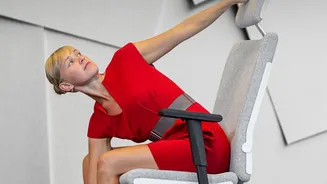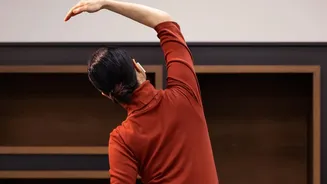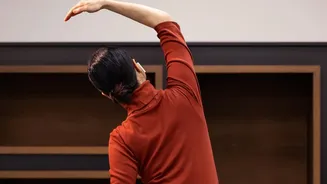






Long hours at a desk often lead to an unwelcome companion: the dreaded slouch. This habit can cause back pain, neck strain, and stiffness. The good news is you can fight back without leaving your workspace with these simple movements.
Why Posture Matters More Than You Think
Before diving into
the exercises, it's important to understand why 'sitting up straight' is about more than just appearances. Prolonged slouching places significant stress on your spine, particularly your neck and lower back. This can lead to chronic pain, joint issues, and even affect digestion and breathing. When you hunch forward, some muscles become tight and shortened (like those in your chest), while others become stretched and weak (like those in your upper back). This imbalance reinforces the slouching cycle. The goal of posture exercises is to counteract these effects by activating weak muscles and stretching tight ones, restoring balance to your body.
The Chin Tuck for Tech Neck
One of the most common issues for desk workers is 'tech neck', where the head drifts forward to look at a screen. The chin tuck directly counters this. Sit or stand tall, looking straight ahead. Gently draw your head and chin straight back, as if you're making a double chin. Be careful not to tilt your head up or down. You should feel a stretch at the back of your neck. Hold this position for 5 seconds and then relax. Aim to repeat this 10 times. It's a subtle but powerful move to realign your head over your spine.
Shoulder Blade Squeezes to Open the Chest
Hunching rounds the shoulders forward, which tightens chest muscles. Shoulder blade squeezes, also known as scapular retractions, activate the weak muscles in your upper back to pull your shoulders into a better position. While sitting or standing, keep your arms relaxed at your sides. Gently squeeze your shoulder blades together as if you're trying to hold a pencil between them. Hold the squeeze for 5-10 seconds, making sure not to shrug your shoulders up toward your ears. Release and repeat 10-15 times throughout the day to combat shoulder rounding.
The Doorway Chest Stretch
This stretch is the perfect antidote to tight chest muscles from hours of hunching. Stand in an open doorway. Place your forearms on the doorframe with your elbows bent at a 90-degree angle, around shoulder height. Take a small step forward with one foot until you feel a gentle stretch across your chest and the front of your shoulders. Breathe deeply and hold the stretch for 20-30 seconds. Avoid pushing so far that you feel pain. This is an excellent stretch to do during a quick break to open up your posture.
Seated Cat-Cow for Spinal Mobility
Your spine isn't meant to stay in one position all day. The seated cat-cow brings gentle movement to your vertebrae, relieving stiffness. Sit at the edge of your chair with your feet flat on the floor and hands on your knees. On your inhale, arch your back, push your chest forward, and look up slightly (Cow). On your exhale, round your spine, tuck your chin to your chest, and let your shoulders curve forward (Cat). Flow between these two positions for 10 repetitions, moving with your breath to gently mobilise your entire spine.
Wall Angels for Shoulder and Back Strength
Wall angels are fantastic for training your body to maintain proper alignment and strengthening key posture muscles. Stand with your back against a wall, with your feet a few inches away from it. Try to have your tailbone, upper back, and head touching the wall. Bend your elbows to 90 degrees and raise your arms to the side like a goalpost, pressing your forearms and the back of your hands against the wall as much as possible. Slowly slide your arms up the wall, keeping contact, then slide them back down. Go as high as you can without your back arching or your arms lifting off the wall. Perform 10–12 slow repetitions.