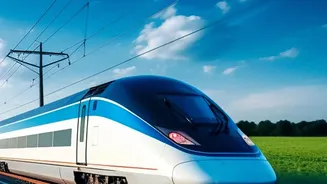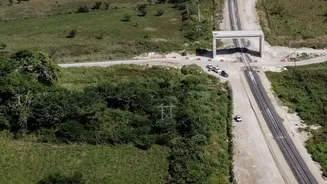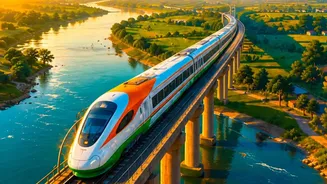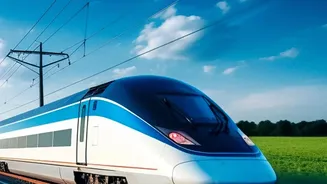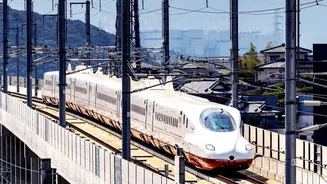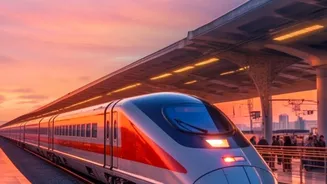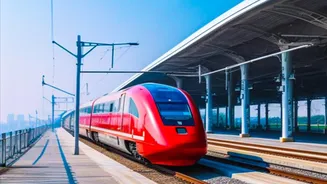

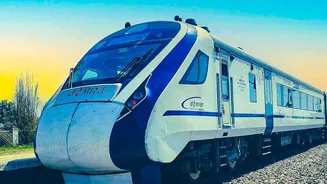
India's dream of a high-speed rail network is becoming a reality, and the first tracks are being laid in Gujarat. The Surat-Vapi section of the Mumbai-Ahmedabad corridor is on track to be the first part of the bullet train project to welcome passengers.
The Big Picture: India's Bullet Train
The Mumbai-Ahmedabad High-Speed Rail Corridor (MAHSR) is India's pioneering venture into the world of bullet trains. Spanning a distance of 508 kilometres, the project aims to connect the financial hubs of Mumbai and Ahmedabad, with 12 stations planned along the route. The goal is to slash travel time between the two cities to just under two hours, a massive reduction from the current eight to nine hours by road. The project, which officially began construction in 2021 after some initial delays, is being developed with technological assistance from Japan, drawing on its world-renowned Shinkansen system known for its safety and efficiency.
Why Surat to Vapi First?
The decision to prioritise the Surat-Vapi stretch is strategic. This section, located entirely within Gujarat, has seen faster progress in land acquisition and construction compared to the more complex terrain in Maharashtra. Railway Minister Ashwini Vaishnaw confirmed that this part of the corridor will be the first to open for service, with a target launch in the final quarter of 2027. This phased approach allows the National High Speed Rail Corporation Limited (NHSRCL), the body implementing the project, to operationalise completed sections and gather valuable data while the more challenging parts of the corridor are finished.
Construction Milestones and Progress
The work on the ground is advancing at a rapid pace. As of late 2026, significant progress has been made across the corridor. Pier work has been completed over 456 kilometres and the viaduct, the elevated structure the train will run on, is complete for 371 kilometres. Civil construction at eight stations is finished, with architectural work now in progress. In a major step towards readiness, the overhead electrical equipment on the 50-kilometre Surat-Bilimora section was successfully energised in November 2026, paving the way for testing. To minimise noise, hundreds of thousands of noise barriers have also been installed along the elevated tracks.
Indigenous Trains and Undersea Tunnels
While the project uses Japanese technology, a key aspect is the development of indigenous manufacturing capabilities. An Indian-made B28 trainset, designed for speeds of up to 280 kmph, is being built by Integral Coach Factory (ICF) and BEML. The first body frame is already undergoing structural tests, with track trials scheduled for mid-2027. Meanwhile, one of the project's most significant engineering challenges is the construction of a 21-kilometre tunnel in Maharashtra. This includes a 7-kilometre section that will pass under Thane Creek, marking India's first-ever undersea rail tunnel. Two massive tunnel boring machines were deployed in July 2026 to carry out this complex excavation.
The Impact on Gujarat and Beyond
The launch of the Surat-Vapi section is more than just an infrastructure milestone; it promises to be a catalyst for economic growth in one of India's most industrialised belts. For cities like Surat and Vapi, already hubs for commerce and industry, the high-speed link will enhance connectivity to Mumbai, making them even more attractive for businesses and homebuyers. The dramatic reduction in travel time could transform how people commute, work, and live, potentially boosting real estate and creating new economic opportunities along the entire corridor. This first operational stretch will serve as a crucial proof of concept, setting the stage for the expansion of high-speed rail across the nation.