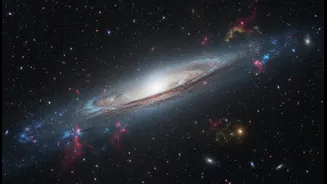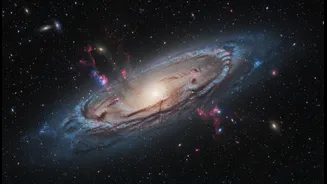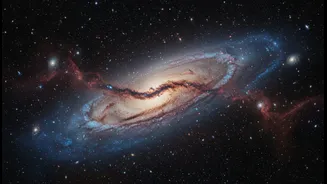





What is Centaurus A?
Think of Centaurus A as the dramatic, fascinating neighbor who’s had a very eventful life. Located about 11 to 12 million light-years away, it's one of the closest radio galaxies to Earth. In astronomical terms, that's just down the street. What makes
it so special is its peculiar look. It appears to be a large elliptical galaxy that has been sliced in half by a thick, dark band of dust. Astronomers believe this is the aftermath of a massive cosmic collision. Roughly 2 billion years ago, a large elliptical galaxy likely merged with a smaller, spiral galaxy. This galactic smash-up created the warped disk of dust and triggered intense bursts of star formation, making Centaurus A a living laboratory for studying how galaxies evolve.
Webb's Infrared Superpower
Previous telescopes, like the Hubble, have given us beautiful images of Centaurus A, but they were always limited by that huge band of dust. Visible light can't penetrate it, leaving the galaxy's core mostly hidden. This is where the James Webb Space Telescope (JWST) changes the game. Webb is designed to see the universe in infrared light. This allows it to peer straight through the dense dust clouds that act like cosmic smoke screens. While older infrared telescopes like Spitzer could see some of the larger structures, they lacked the sharpness to resolve fine details. Webb's powerful mirrors and sensitive instruments, MIRI and NIRCam, provide both the infrared vision and the incredible resolution needed to see individual stars and delicate structures that were previously just a blur.
Decoding the Dazzling New Image
The latest image is a composite view, combining data from Webb's near- and mid-infrared instruments to create a spectacular portrait. What once looked like a smooth, hazy glow is now revealed to be a dense field of millions of individual stars. The famous dust lane is no longer just a dark slash but a richly textured, glowing structure of golden-orange filaments and knots. At the galaxy's heart, the actively feeding supermassive black hole shines brightly, while Webb's MIRI instrument highlights wispy ribbons of dust and gas forming a mysterious S-shaped structure nearby. Scientists are still trying to understand this feature, but it's likely connected to the turmoil from the ancient merger and the activity of the black hole.
What We're Learning From It
This image is far more than just a pretty picture. By resolving individual stars, astronomers can now perform 'galactic archaeology.' They can distinguish between different generations of stars, figuring out which existed before the collision, which were born during the violent merger, and which have formed since. This provides a detailed historical record of the galaxy. Furthermore, the image offers new clues about the complex relationship between a supermassive black hole and its host galaxy. Webb can see gas rotating near the black hole while other streams of material are being pushed away. This shows how a black hole can both trigger star formation by compressing gas and stifle it by blasting material out of the galaxy, a cosmic balancing act that shapes the evolution of the entire system.