


What Is an Equinox?
The word equinox comes from the Latin for "equal night," referencing the idea that day and night are of nearly equal length across the globe. Astronomically, an equinox is the exact moment when the Sun crosses the celestial equator—an imaginary line in the sky
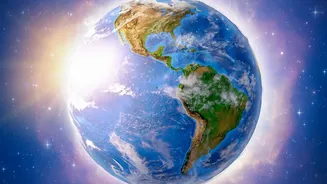
directly above Earth's Equator. At this time, Earth's axis is not tilted toward or away from the Sun. Instead, it's perfectly side-on. This results in the Sun's rays shining directly down on the Equator, bathing both the Northern and Southern Hemispheres in almost identical amounts of light. There are two equinoxes each year: one in March, which signals the start of spring in the Northern Hemisphere, and one in September, which ushers in autumn.
Mark Your Calendars for September 2026
The September equinox for 2026 will occur at 00:06 Coordinated Universal Time (UTC) on September 23. For India, this corresponds to 5:36 AM Indian Standard Time (IST) on September 23. It’s a specific, fleeting moment that occurs for the entire planet simultaneously, regardless of your time zone. For the Northern Hemisphere, this event is called the autumnal equinox and marks the astronomical start of autumn. South of the equator, the opposite is true; it's the vernal (spring) equinox.
The Tilt Is the Reason for the Season
The primary reason we have equinoxes, solstices, and seasons is not our planet's distance from the Sun, but its tilt. Earth spins on an axis that is tilted at an angle of about 23.5 degrees. This tilt remains constant as our planet journeys around the Sun. For part of the year, the Northern Hemisphere is tilted toward the Sun, receiving more direct and concentrated sunlight, which brings us summer. Six months later, it’s tilted away, resulting in the less direct sunlight and cooler temperatures of winter. The equinoxes are the halfway points in this cycle, when neither hemisphere is tilted more toward the Sun than the other. This is the simple, elegant dance of orbital mechanics that governs our seasons.
The Myth of a Perfectly Equal Day
Contrary to its name, the equinox doesn't feature a day and night of exactly 12 hours. The day is actually slightly longer than the night. There are two main reasons for this. First, sunrise is officially marked when the upper edge of the Sun becomes visible over the horizon, and sunset is when its last edge disappears. Because the Sun is a disk and not a point of light, this gives us a few extra minutes of daylight. Second, Earth’s atmosphere bends sunlight, a phenomenon known as refraction. This bending makes the Sun appear on the horizon a few minutes before it has physically risen and keeps it visible for a few minutes after it has set, adding even more time to the daylight period. The day when day and night are closest to being equal is called the equilux, and it occurs a few days after the autumn equinox.
Astronomical vs. Meteorological Seasons
While the equinox marks the beginning of the astronomical autumn, you may have heard meteorologists say that autumn began on September 1. This is because scientists use two different systems. Astronomical seasons are determined by Earth’s position relative to the Sun—the equinoxes and solstices. Their dates can vary slightly each year. Meteorological seasons, however, are based on the annual temperature cycle and are divided into clean three-month blocks that align with our calendar. For forecasting and climate data comparison, meteorologists define autumn in the Northern Hemisphere as September, October, and November. This fixed schedule makes it easier to track and compare seasonal weather patterns year after year.
A Time of Balance and Celebration
Across cultures and throughout history, the autumnal equinox has been a time of significance, often linked to harvest and balance. In India, the period around the September equinox aligns with Sharad Navaratri, a major nine-night festival celebrating the goddess Durga and the triumph of good over evil. It is seen as a time of thanksgiving for the harvest and a spiritual moment recognizing the balance between light and darkness. This connection reflects a universal human tendency to mark these celestial turning points with rituals of gratitude, reflection, and preparation for the season ahead.