


The Invisible Threat
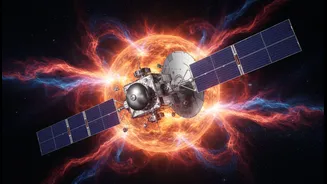
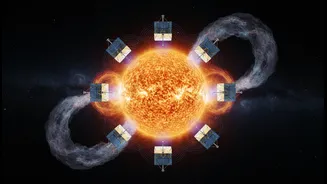
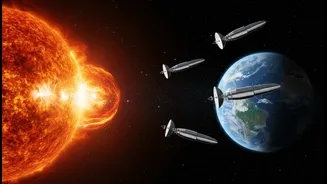
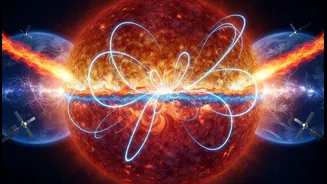
The Sun, our life-giving star, occasionally unleashes violent outbursts of energy and matter. The most powerful of these are called Coronal Mass Ejections (CMEs), which are massive clouds of magnetized plasma and radiation hurled into space. If one of these storms
hits Earth, it can induce powerful electrical currents in our planet's magnetic field. The consequences for our tech-reliant society could be catastrophic. These geomagnetically induced currents can flow into our power grids, overheating and destroying critical transformers, leading to widespread and potentially long-lasting blackouts. A notable example occurred in Quebec, Canada, in 1989, when a solar storm caused a power failure that affected millions for nine hours. Beyond the grid, these storms can damage orbiting satellites, disrupting everything from GPS navigation to financial transactions and telecommunications.
A New Kind of Solar Observatory
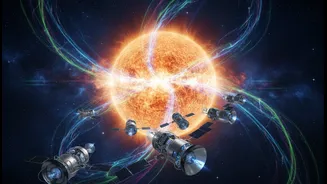
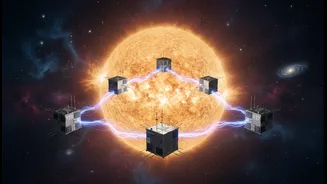
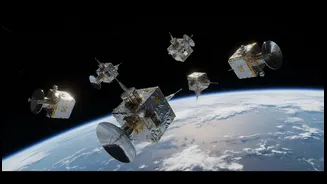
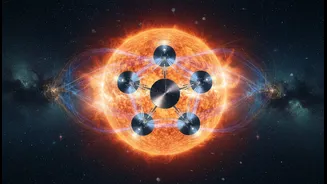
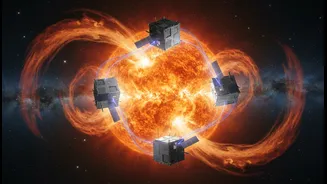
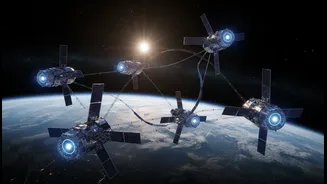
Typically, we think of a space telescope as a single, large instrument. The Sun Radio Interferometer Space Experiment, or SunRISE, breaks that mold. It is not one satellite but a team of six. Each spacecraft is roughly the size of a toaster oven, a class of small satellite known as a CubeSat. These six satellites are designed to fly in a precise formation high above Earth's atmosphere, spread out over an area about 10 kilometres wide. Working together, they use a technique called interferometry to function as a single, giant virtual radio telescope. This innovative approach allows scientists to achieve the power of a massive observatory without the cost and complexity of building and launching a single, enormous spacecraft.
Listening for Solar Whispers
The key to SunRISE's forecasting ability lies in what it listens for. The mission is tuned to detect low-frequency radio waves that are generated during the early stages of a solar eruption. These specific radio signals, known as Type II bursts, are a tell-tale sign that a CME is accelerating particles and beginning its journey out from the Sun. Crucially, these long-wavelength radio signals are completely blocked by a layer of Earth's own atmosphere called the ionosphere. This is why no ground-based telescope can see them; to get the full picture, you have to be in space. By positioning the SunRISE constellation in a high geosynchronous orbit, it can eavesdrop on these solar whispers that would otherwise be lost, giving scientists a direct insight into the storm's birth.
The 3D Advantage
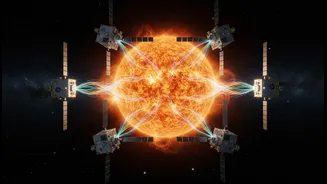
Detecting a storm is one thing; knowing where it's going is another. This is where the constellation design of SunRISE becomes truly powerful. Because the six satellites are physically separated, each one receives the radio signal from a slightly different position and at a slightly different time. By combining the data from all six spacecraft, scientists on the ground can create a detailed 3D map of the radio emissions. This allows them to pinpoint the origin of the storm on the Sun and, most importantly, to track its path, speed, and expansion as it travels through space. This 3D view is what will help determine if a dangerous particle storm is aimed directly at Earth or if it will pass by harmlessly, transforming space weather forecasting from a 2D snapshot into a 3D moving picture.
Why Earlier Warnings Matter
The advance notice provided by SunRISE could translate into a critical window of opportunity to protect our infrastructure. While the fastest particles from a solar flare can reach Earth in minutes, the bulk of a damaging CME takes one to several days to arrive. SunRISE's ability to see the initial eruption and track its trajectory provides a more reliable and earlier warning than current methods. With this extra time, power grid operators could take preventative measures to protect vulnerable transformers from overload. Satellite operators could put their expensive assets into a protective safe mode to weather the storm. For future crewed missions to the Moon and Mars, such a warning system would be essential, giving astronauts time to seek shelter from potentially lethal solar radiation. In a world more connected and electrified than ever, this mission is a vital investment in planetary defence against one of nature's most powerful threats.