




The Urban Astronomer's Challenge
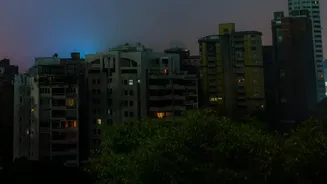
Trying to spot constellations from a city balcony can feel like a hopeless task. The culprit is light pollution, the excessive and misdirected artificial light from buildings, streetlights, and cars that floods the night sky. This glow washes out all
but the brightest celestial objects, hiding the Milky Way, faint stars, and distant galaxies from view. For generations, this meant that appreciating the cosmos was a privilege reserved for those who could travel far from urban centres. But the device you carry in your pocket has changed the game, offering a digital window to the universe that our ancestors could only dream of.
Your Phone’s Built-in Observatory
Modern smartphones are packed with an array of sophisticated sensors that make these astronomy apps possible. They don't just have a camera; they have a GPS to pinpoint your exact location on Earth, a magnetometer to act as a compass, and an accelerometer and gyroscope to determine the angle and direction you're holding the phone. When you launch a stargazing app, it instantly gathers this data. It knows your precise latitude and longitude, the exact time, and exactly where you are pointing the device in the sky. This combination of sensors allows the app to create a perfectly aligned map of the heavens from your unique vantage point.
Mapping the Entire Cosmos
The other half of the magic lies in the app's database. These applications contain vast star catalogs, sometimes with data on hundreds of thousands of celestial objects. Every star, planet, nebula, and galaxy has a known coordinate in the sky, much like a city has a longitude and latitude on a map. The app’s software performs complex calculations to determine where each of these objects should be in the sky relative to your specific time and location. This process is so efficient that the map on your screen is redrawn multiple times a second as you move your phone, creating a seamless, real-time guide.
Augmented Reality: Your Window to the Stars
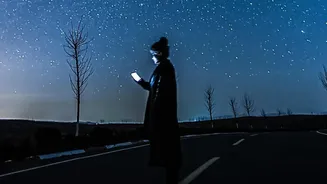
This is where it all comes together. The feature that feels most like magic is called augmented reality, or AR. Many apps use your phone's camera to show you the real-world view of the sky and then overlay their digital star map on top of it. Suddenly, that faint dot you can barely see is labelled as Jupiter. Invisible patterns are connected with lines to reveal the shape of a constellation like Orion or Ursa Major. The app isn't showing you a different sky; it's augmenting your sky, showing you what is there, even if it's too faint for your eyes to see through the urban haze.
So, How Do They 'Filter' Light?
The headline's term 'filter' is more of a metaphor for the final effect than a literal description of the process. The apps do not optically remove light pollution from your camera's view. Instead, they bypass the problem entirely. Because the app knows the precise location of every star and planet, it simply draws them on your screen in their correct positions, regardless of the light pollution. You aren't seeing the planet through the glow; you are seeing a digital representation of the planet overlaid where it should be. Some advanced apps like Stellarium do allow you to simulate different levels of light pollution, which can help you understand what might be visible to the naked eye versus what the app is showing you. This feature helps manage expectations by showing which objects are truly hidden by the city lights.
More Than Just Finding Planets
The capabilities of these apps extend far beyond simple identification. Many include features that let you travel through time, showing you the sky on any date in the past or future. You can see what the celestial alignment was on the day you were born or witness a future eclipse. They also track thousands of man-made objects, sending you notifications when the International Space Station (ISS) is about to pass overhead. With detailed information on mythology, science, and history for nearly every object you tap on, these apps serve as interactive encyclopedias for the cosmos, accessible anytime and anywhere.