




Beyond 'Frugal Engineering'
For decades, the Indian Space Research Organisation (ISRO) built a global reputation on the back of “frugal engineering.” It masterfully executed complex missions, like the Mars Orbiter Mission (Mangalyaan) and the Chandrayaan lunar landings, at a fraction
of the cost of its international counterparts. This approach established India as a serious and reliable spacefaring nation. But today, the strategy is evolving. While cost-effectiveness remains a core principle, ISRO is aggressively integrating cutting-edge technologies that promise to redefine what's possible. The new ambition isn't just about doing more with less; it's about pioneering capabilities for safer, smarter, and more sophisticated exploration of the cosmos. This pivot towards AI and quantum computing signals a fundamental shift from being a budget-conscious player to a technology-driven leader in the next generation of space exploration.
AI as the Ultimate Mission Co-Pilot
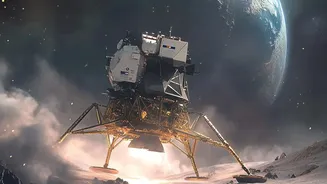
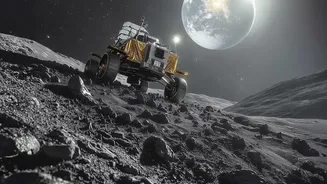
Artificial intelligence is quickly becoming an indispensable tool for ISRO, acting as a digital co-pilot across numerous domains. One of its most significant roles is in analyzing the immense volumes of data sent back by Earth observation satellites. AI algorithms can sift through petabytes of imagery to monitor deforestation, predict crop yields, track urban expansion, and provide crucial data for disaster management, turning raw information into actionable insights with unprecedented speed. Beyond data analysis, AI is crucial for autonomous operations. For the Chandrayaan-3 mission, AI-powered sensors and algorithms helped the lander identify a safe and hazard-free touchdown spot on the lunar surface in real-time. This same technology is being developed for future rovers and deep-space probes, allowing them to navigate complex terrain and make independent decisions without constant ground control. It's also being used to monitor the health of satellites and launch vehicles, predicting potential issues before they become critical failures.
The Quantum Leap to Unbreakable Security
While AI makes missions smarter, quantum technology promises to make them secure. The primary focus is on Quantum Key Distribution (QKD), a technology that uses the principles of quantum mechanics to create theoretically unhackable communication channels. For a space program, this is a game-changer. It ensures that sensitive data—from military satellite communications to commands sent to a spacecraft—is immune to interception and decryption, even from future quantum computers that could break today's encryption standards. ISRO has already made significant strides, successfully demonstrating free-space QKD over a distance of 300 meters, a critical step toward implementing satellite-based quantum communication. Researchers have identified high-altitude locations like Hanle in Ladakh as ideal sites for ground stations to beam these quantum signals to satellites, paving the way for a secure communications network spanning land and space. This technology is seen as essential for protecting critical infrastructure like navigation and reconnaissance satellites.
A New Blueprint for Space Exploration
The true power of this new strategy lies in the synergy between AI and quantum tech. Imagine a future Indian mission to Mars or the establishment of the planned Bharatiya Antariksh Station. AI-driven systems could manage the station’s life support, conduct autonomous scientific experiments, and navigate rovers on distant planets. All the while, the data and commands flowing between these assets and Earth would be protected by quantum encryption, ensuring mission integrity and security. This combination enables more ambitious and complex undertakings, from managing space traffic to conducting long-duration human spaceflights like the Gaganyaan program. By developing these capabilities in-house, India is not only enhancing its own program but also positioning itself as a key partner for international collaborations in an increasingly complex and competitive space environment. This technological fusion is the blueprint for India's next chapter in space—one defined by innovation, autonomy, and security.