


The Fiery Challenge of Arrival
For any probe, lander, or crewed capsule, arriving at a planet with an atmosphere is a trial by fire. A craft can hit the upper atmosphere at speeds of over 28,000 kilometres per hour, generating temperatures hot enough to melt steel. The key to survival
is shedding that velocity as quickly and safely as possible. For decades, engineers have relied on rigid, solid heat shields, like the tiles on the Space Shuttle or the ablative shields on the Apollo capsules. These work, but they have a crucial limitation: they can only be as wide as the rocket fairing that carries them into space. This size constraint is a major roadblock for future ambitions, especially for landing heavy payloads like human habitats or large rovers on Mars, where the thin atmosphere makes slowing down particularly difficult.
The Inflatable Solution: Bigger is Better
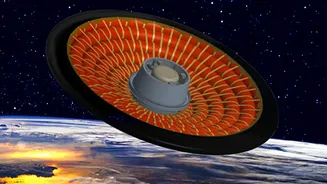
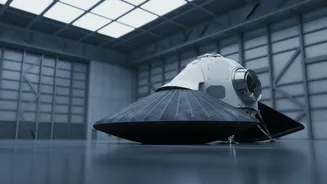
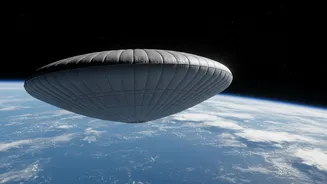
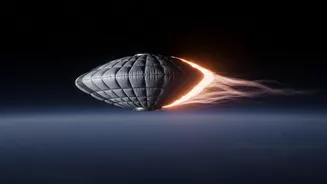
Inflatable heat shields, officially known as Hypersonic Inflatable Aerodynamic Decelerators (HIADs), solve the size problem. Instead of a rigid dish, a HIAD is a structure made of high-tech, heat-resistant fabrics that can be packed into a small volume for launch. Before atmospheric entry, it inflates with nitrogen gas, deploying into a large, mushroom-shaped shield that is much wider than a rocket's nose cone would allow. This larger diameter creates significantly more drag. Think of it like the difference between dropping a stone and a feather; the feather's larger surface area relative to its weight causes it to drift down slowly. By starting the deceleration process higher up in the thinner parts of the atmosphere, a HIAD can slow a spacecraft more gently and effectively.
Engineering for Extreme Conditions
Creating a 'balloon' that can survive hypersonic speeds and intense heat is an engineering marvel. The structure consists of concentric rings, or tori, woven from synthetic polymers that are, by weight, stronger than steel. These rings provide the rigid shape when inflated. The side facing the intense heat of re-entry is covered by a flexible thermal protection system. This is a multi-layered blanket made of materials like silicon carbide ceramic fabric, which can withstand the extreme temperatures. Beneath this outer layer are flexible insulation materials that prevent heat from reaching the inflatable structure itself, ensuring it remains intact throughout the fiery descent.
A Successful Test Run in Space
This technology is not just theoretical. In late 2022, NASA successfully tested a six-metre-wide version called the Low-Earth Orbit Flight Test of an Inflatable Decelerator (LOFTID). Launched as a secondary payload, the LOFTID vehicle inflated in orbit and successfully re-entered Earth’s atmosphere, surviving speeds of nearly Mach 29 and splashing down safely in the Pacific Ocean. The test was declared a 'huge success' by NASA, confirming that the structure and its thermal protection system performed as designed. It demonstrated that the technology could withstand forces and heating representative of a mission to Mars, proving it is ready for operational use on future missions.
Unlocking the Future of Planetary Exploration
The success of inflatable heat shields is a game-changer for deep-space exploration. The ability to land heavier payloads is critical for establishing a human presence on Mars, which requires delivering habitats, supplies, and ascent vehicles far larger than anything landed so far. The current record holder, the Perseverance rover, weighs about one metric ton; a human mission could require landing payloads of 40 tons or more. HIAD technology makes this feasible. It not only enables missions to Mars but also to other destinations with atmospheres, like Venus or Saturn's moon Titan. Furthermore, the technology could be used to safely return large components, or even entire rocket stages, to Earth, paving the way for more reusable and cost-effective spaceflight.