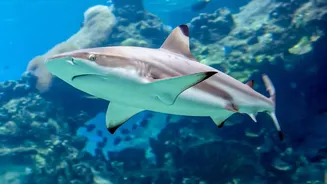



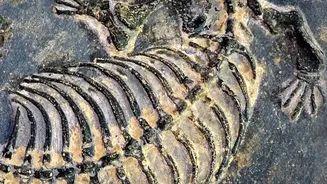


It’s a surprising fact: the ocean's most formidable predators don't have a single bone in their body. Instead, sharks navigate the deep with a skeleton made entirely of cartilage. This isn't an evolutionary oversight, but a masterpiece of adaptation.
What is a Cartilaginous Skeleton?
Sharks belong to a group of fish called Chondrichthyes, a name that literally means 'cartilage fish'. Their entire internal framework—skulls, fins, and spines—is composed of cartilage, the same flexible, resilient connective tissue found in human ears and noses. While it's much softer than bone, it isn't fragile. In areas that require extra strength, like the jaws and vertebrae, the cartilage is reinforced with mineral deposits, a structure known as tessellated cartilage. This gives it impressive strength and durability without the weight of a true bony skeleton.
The Advantage of Being Lightweight
One of the biggest advantages of a cartilage skeleton is its low density; it's about half as dense as bone. This lightness is crucial for sharks because, unlike most bony fish (Osteichthyes), they do not have a swim bladder—a gas-filled organ that controls buoyancy. Without a swim bladder, a heavy, bony skeleton would require a shark to expend enormous energy just to stay afloat. Their lightweight frame, combined with a large, oil-filled liver, provides natural buoyancy, allowing them to glide through the water with remarkable efficiency.
Flexibility Equals Agility
A cartilage frame is not just light; it's also incredibly flexible. This allows sharks to be highly agile swimmers, capable of making tight turns and rapid changes in direction to catch swift prey. Their flexible jaws are another significant advantage, enabling them to open their mouths wider and protrude their jaws forward to secure a better grip, contributing to their famously powerful bite. The very structure of a shark's spine acts like a spring, storing and releasing energy with every tailbeat, propelling them gracefully and powerfully through the water.
An Evolutionary Twist
For a long time, scientists believed that cartilage was a primitive trait and that sharks simply never evolved to have bones. However, recent fossil discoveries are challenging this idea. The unearthing of ancient fish with bony skeletons, who are believed to be related to the ancestors of sharks, suggests a more complex story. The current thinking is that sharks may have evolved from ancestors that had bones and then, over time, lost this trait in favour of a lighter, more flexible cartilaginous skeleton. This 'secondary loss' would have been a powerful evolutionary adaptation, helping sharks become more mobile and successful global predators.