
A Storm for the Ages
For at least 150 years, and possibly much longer, astronomers have trained their telescopes on Jupiter's most famous feature: the Great Red Spot. It’s not a storm in the earthly sense; it’s a colossal anticyclone, a high-pressure system of swirling gases
that is wider than our entire planet. Unlike hurricanes on Earth that form over water and die over land, the Great Red Spot has no solid surface to slow it down. It exists in a dynamic equilibrium, sandwiched between two powerful jet streams moving in opposite directions, which have helped sustain it for centuries. At its peak in the late 1800s, this vortex was vast enough to swallow three Earths. However, for the last century, observers have noted a consistent trend: the spot is shrinking.
An Unprecedented New Look
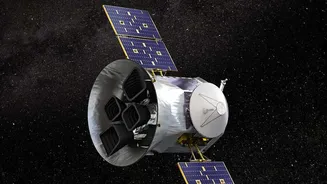
The latest insights come from a combination of powerful observatories, including NASA's Hubble Space Telescope and the Juno spacecraft, which has been orbiting Jupiter since 2016. While the headline's 'new camera' refers to the ongoing, advanced observations from these missions, it's the synergy between them that's revolutionary. Juno's instruments can peer deep beneath the cloud tops, measuring the storm's structure and depth, while Hubble provides stunningly high-resolution images of the upper atmosphere in various wavelengths of light. These combined efforts create a more complete, three-dimensional view of the storm's mechanics than ever before, revealing features that were previously impossible to discern.
Inside the 'Cosmic Tornados'
The term 'cosmic tornados' poetically describes the smaller vortices and eddies that churn within and around the Great Red Spot. These are not separate storms but integral parts of the larger system’s dynamics. The new, detailed views have shown these smaller swirls feeding into the main vortex, a process scientists believe might be connected to its ongoing transformation. In some images, wispy filaments can be seen being stretched and twisted by the storm's ferocious winds, which can reach speeds over 430 kilometres per hour. By tracking the movement and interaction of these smaller features, scientists hope to better understand the flow of energy that powers the massive storm and what might be causing its gradual decline.
The Incredible Shrinking Storm
The shrinking of the Great Red Spot is one of the biggest active mysteries in planetary science. Observations show its diameter has reduced significantly, from over 23,000 kilometres across during the Voyager flybys in 1979 to roughly 14,000 kilometres in recent years. The storm is not only getting smaller but also more circular in shape. Why is this happening? No one is entirely certain. Some theories suggest that changes in the jet streams that contain it, or the way it absorbs smaller storms, are altering its energy balance. Other research suggests the visible red cloud deck may be changing, while the underlying vortex remains powerful. Recent Hubble observations even detected the storm jiggling and oscillating in size, adding another layer of complexity to its behaviour.
Why Jupiter's Weather Matters
Studying the extreme weather on Jupiter does more than satisfy our curiosity about a distant world. It provides a natural laboratory for understanding atmospheric physics under conditions impossible to replicate on Earth. Jupiter is a gas giant, composed primarily of hydrogen and helium, with an atmosphere that is thousands of kilometres deep. The dynamics that drive its storms, including heat rising from deep within the planet's interior, can inform our models of planetary climates everywhere, including on exoplanets orbiting other stars. Understanding the forces that create, sustain, and eventually dissipate a storm as long-lived as the Great Red Spot helps refine our knowledge of fluid dynamics and meteorology on a cosmic scale.