

The Fuel Problem in Space
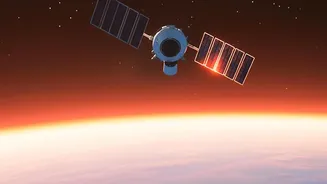
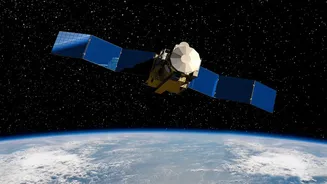
For decades, satellites have relied on chemical propulsion. Think of it like a car's engine: it burns liquid fuel to produce a powerful, immediate burst of thrust. This is perfect for the initial, heavy-lifting phase of getting a satellite from its transfer
orbit to its final destination, 36,000 kilometres away. The problem is that chemical propellants are heavy and inefficient for the long haul. A typical 2,000-kg communication satellite might need to carry nearly half its weight in chemical fuel. This fuel is used not just for the initial orbit-raising but also for tiny, periodic adjustments—called station-keeping—to fight gravitational pulls and maintain its precise location. Once this fuel runs out, the satellite’s useful life is over, even if its electronics are perfectly fine.
Enter Electric Propulsion
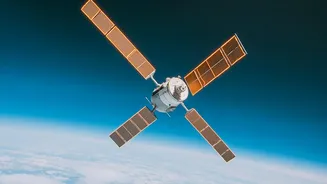
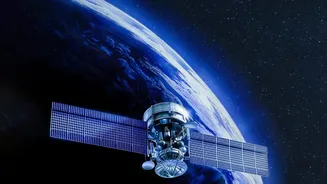
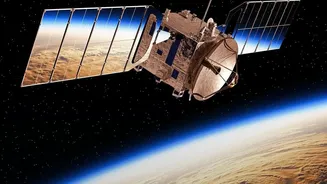
Electric propulsion (EP) offers a revolutionary alternative. Instead of burning fuel, it uses electrical power, typically generated by the satellite's large solar panels, to accelerate and expel a propellant. This isn't a new concept—the first EP systems flew in the 1960s—but perfecting them for long, reliable missions has been a modern challenge. ISRO has embraced this technology, first testing it as a demonstrator on the GSAT-9 satellite and now moving towards fully electric satellites. These systems are five to six times more efficient than their chemical counterparts, fundamentally changing a satellite's design and capabilities. They promise to replace traditional chemical systems for both orbit raising and long-term station keeping.
Sipping Fuel, Not Gulping It
The most common type of electric propulsion used today is the Hall-effect thruster. These devices use solar power to create electric and magnetic fields. A very small amount of an inert gas, like xenon, is fed into the thruster. The fields strip electrons from the xenon atoms, turning them into positively charged ions. These ions are then accelerated by an electric field and shot out of the thruster at incredibly high speeds—between 10 and 80 km/s. This high-speed exhaust creates a gentle but continuous thrust. While a chemical thruster is like a powerful cannon, a Hall thruster is like throwing an endless stream of sand grains at extremely high velocity. Each push is tiny, but over days and weeks, it achieves significant changes in velocity with incredible fuel efficiency.
The Endurance and Payload Advantage
This phenomenal efficiency directly translates to extended orbital endurance. Because an electric propulsion system "sips" its propellant instead of gulping it, a satellite can perform station-keeping maneuvers for many more years. A mission that might last 12 years on chemical fuel could be extended to 15 years or more. This directly increases the return on investment for each launch. Furthermore, the mass savings are enormous. Where a satellite once needed over 800 kg of chemical fuel, an EP system might require only 100-200 kg of xenon propellant. This saved weight—or 'mass budget'—can be used to pack the satellite with more transponders or more powerful scientific instruments, boosting its revenue-generating or data-collecting capacity.
Powering India’s Space Ambitions
ISRO's development of indigenous Hall thrusters is a strategic leap. The agency has successfully tested its own Stationary Plasma Thrusters, a key step towards self-reliance. Upcoming satellites like the GSAT-20 (also known as GSAT-N2) are designed to leverage these benefits for high-throughput communication, delivering broadband services across India, including remote islands. While GSAT-20 itself will use a conventional bi-propellant system for its main orbit-raising, the groundwork is being laid for future satellites to be fully electric. This technology is not only for communications satellites; its high efficiency makes it ideal for long-duration interplanetary missions, where slow, continuous acceleration is a major advantage. By mastering electric propulsion, ISRO is ensuring its satellites are not just launched, but are more capable, live longer, and provide more value than ever before, cementing India's position as a major player in the global space economy.