

A Star Is Born (and Dies)
In early October 1604, observers across Europe and Asia noted a stunning new light in the constellation Ophiuchus, the Serpent Bearer. Initially spotted in Italy on October 9, it quickly grew to outshine every star and most planets in the night sky. For
over three weeks, it was even visible in broad daylight. This 'new star', or 'stella nova', captivated the public and astronomers alike, who were witnessing not the birth of a star, but its violent death. Today, we know this event as SN 1604, a supernova. It remains the most recent supernova to be unquestionably observed within our own Milky Way galaxy.
Kepler's Meticulous Watch
Though he wasn't the first to see it, the event would become inextricably linked with German astronomer Johannes Kepler. Working as the Imperial Mathematician in Prague, Kepler began his own systematic observations on October 17. For over a year, until the star faded from view in 1606, he meticulously recorded its brightness and position. His comprehensive work, 'De Stella Nova in Pede Serpentarii' (On the New Star in the Foot of the Serpent Bearer), became the definitive account of the phenomenon, which is why SN 1604 is famously known as Kepler's Supernova.
The Pre-Telescopic Era's Last Hurrah
The headline's reference to the 'telescope-era' highlights a crucial point of timing. The supernova of 1604 occurred on the very cusp of a revolution. The telescope wasn't patented until 1608, and Galileo Galilei first turned his toward the heavens in 1609. This means that every observation of Kepler's Supernova was made without telescopic aid. Astronomers relied on the naked eye and instruments like quadrants and sextants to measure the star's position relative to other known stars. By proving the new star showed no parallax—a shift in apparent position against the background—they correctly concluded it was located far beyond the Moon, in the realm of the 'fixed' stars.
Shattering the Perfect Heavens
The appearance of a new star in a supposedly unchanging celestial sphere was a profound challenge to the long-held Aristotelian worldview that had dominated Western thought for centuries. This model held that the heavens beyond the Moon were perfect and immutable. A supernova in 1572, observed by Tycho Brahe, had already cracked this foundation. Kepler's Supernova in 1604 delivered another powerful blow. The evidence was undeniable: the heavens were not static. This shift in understanding helped pave the way for new ideas about the cosmos, including the Sun-centered model proposed by Copernicus.
The Modern View of an Ancient Explosion
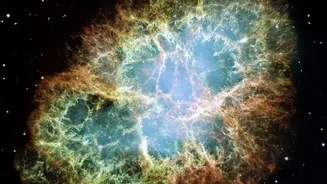
More than 400 years later, modern astronomers continue to study the aftermath of SN 1604. The faint, expanding cloud of gas and dust left behind is known as Kepler's Supernova Remnant. Using powerful instruments like NASA's Chandra X-ray Observatory, scientists have determined that it was a Type Ia supernova. This type of explosion occurs when a dense white dwarf star in a binary system pulls material from its companion until it reaches a critical mass and explodes in a thermonuclear blast. These events are incredibly important to astronomy, as they are used as 'standard candles' to measure vast distances across the universe and understand its expansion.