






Cosmic Lighthouses
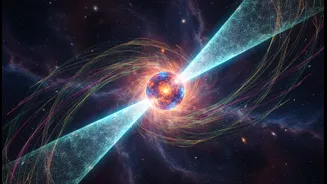
At the heart of this new technique are pulsars, some of the most extreme and fascinating objects in space. A pulsar is a type of neutron star, the incredibly dense core left behind after a massive star explodes. These city-sized objects pack more mass than
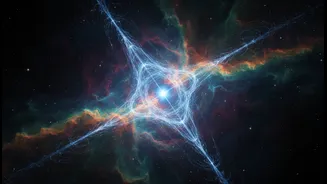
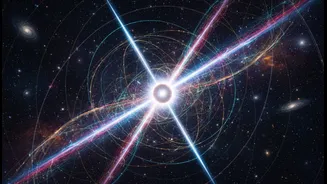
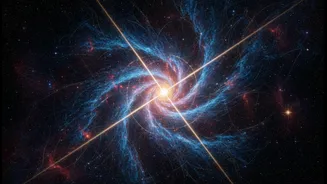
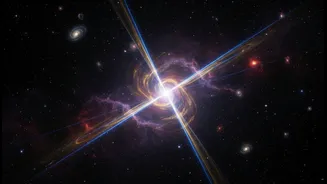
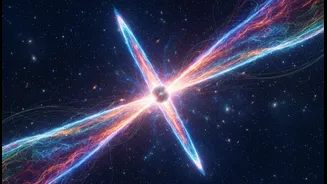
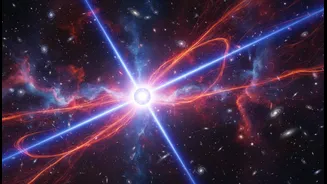
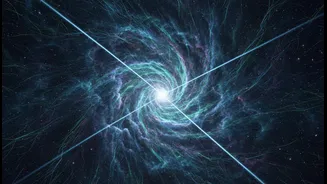
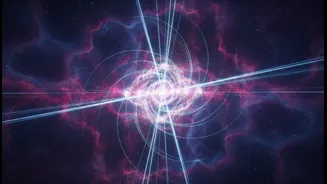
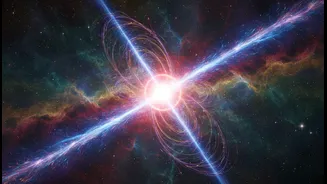
our sun and spin at incredible speeds, some rotating hundreds of times per second. As they spin, they emit powerful beams of radiation from their magnetic poles. From our perspective on Earth, these beams sweep across our view like the rotating lamp of a lighthouse, creating a pulse of light. This is why they are often called cosmic lighthouses, providing a steady, predictable beacon from across the galaxy. This predictable nature makes them perfect reference points for navigation and, as NASA has now shown, for mapping.
The Secret in the Light
The key to this new map isn't just the X-rays coming from these pulsars, but a specific property of that light: its polarization. Think of light as a wave that can oscillate in many different directions. Polarized light is light that has been organized to oscillate in a preferred direction. This often happens when light reflects off a surface or, in the case of pulsars, when it travels through powerful magnetic fields. The direction and degree of polarization in the X-rays carry crucial information about the magnetic fields they have encountered on their journey. By measuring this polarization, astronomers can effectively trace the structure and alignment of these fields, which are otherwise completely invisible to traditional telescopes. It's like learning to read a secret message encoded within the light itself.
Introducing IXPE: The Universe's New Compass
The tool making this all possible is NASA's Imaging X-ray Polarimetry Explorer, or IXPE. Launched in late 2021, IXPE is a space observatory specifically designed to be the first mission dedicated to measuring the polarization of X-rays from a wide variety of cosmic sources. It's a collaboration between NASA and the Italian Space Agency. The satellite has three telescopes that focus X-rays onto special detectors capable of measuring the polarization of even very faint sources. By staring at a pulsar for an extended period—in a recent case involving the "Lighthouse Nebula," for nearly 18 days—IXPE can collect enough polarized photons to build a detailed picture. This allows scientists to map the orientation of the magnetic fields with unprecedented accuracy, essentially giving them a cosmic compass to navigate the unseen.
Mapping the Unseen Structure
So, what is this invisible map actually showing us? The latest results from IXPE, focusing on a pulsar in what's known as the Lighthouse Nebula, have confirmed a nearly two-decade-old theory. Scientists believed that particles streaming from the pulsar were being guided along the galaxy's larger magnetic field lines, creating long, filament-like structures. IXPE's measurements confirmed with over 99% confidence that the magnetic field does indeed align with these particle flows. This provides direct evidence of the universe's magnetic "skeleton," the vast, structured fields that shape how matter and energy are transported across interstellar space. These fields dictate the structure of nebulae, influence star formation, and guide high-energy cosmic rays.
New Puzzles and Future Discoveries
While IXPE confirmed some long-held theories, it also delivered some surprises that are creating new puzzles for astrophysicists. The data from the Lighthouse Nebula showed that the magnetic field was far more orderly and less turbulent than many models had predicted. Furthermore, IXPE found a striking difference between the magnetic field direction seen in X-rays versus what was observed at radio wavelengths, suggesting different physical processes are at work for particles of different energies. This discovery doesn't just answer old questions; it opens up entirely new avenues of research into particle acceleration and the extreme physics at play around neutron stars. It proves that by adding polarization to our toolkit, we are gaining a fundamentally new sense with which to perceive the cosmos.