

From Discovery to Diagnosis
The era of exoplanet discovery has been nothing short of revolutionary. Telescopes like NASA's Kepler mission transformed our understanding of the galaxy, revealing that planets are not a rarity but a common feature, outnumbering the stars. We now know
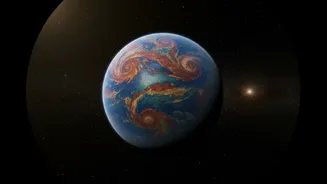
of thousands of confirmed exoplanets, ranging from massive gas giants to small, rocky worlds. But simply knowing a planet exists is like knowing a book exists without ever opening it. The next great chapter in this exploration involves moving from a planetary census to a detailed diagnosis. The focus is no longer just on 'where' these worlds are, but 'what' they are like. This pivot from detection to characterization is a critical step, pushing science closer to answering one of humanity's oldest questions: are we alone in the universe?
The Power of Light
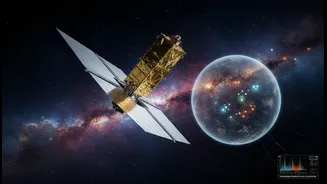
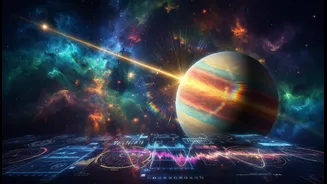
So, how do you study the air of a planet light-years away? The primary technique sounds like science fiction: transmission spectroscopy. When an exoplanet passes in front of its host star from our point of view—an event called a transit—a tiny fraction of the starlight filters through the planet's atmosphere. By capturing this light with powerful instruments, scientists can analyze its spectrum. Different gases and molecules in the atmosphere absorb specific wavelengths, or colors, of light, leaving a unique chemical fingerprint. This is where the James Webb Space Telescope (JWST) has been a game-changer. Its incredible sensitivity in the infrared spectrum allows it to detect the faint signatures of molecules like water vapor, methane, and carbon dioxide, which are invisible to many other telescopes. It’s the difference between seeing a silhouette and being able to read the fine print.
A Chemical Recipe for Life?
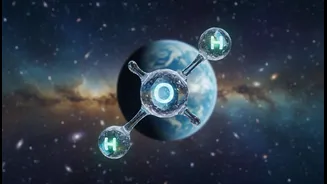
The ultimate goal of analyzing these alien atmospheres is the search for biosignatures—gases or combinations of gases that strongly suggest the presence of life. On Earth, for example, the high concentration of oxygen is a direct result of photosynthesis. Oxygen is highly reactive and wouldn't persist in our atmosphere without being constantly replenished by living organisms. Therefore, finding oxygen, especially in combination with other gases like methane, could be a powerful indicator of biological activity. However, it's not that simple. Scientists must be careful to rule out non-biological processes that could mimic these signs. A combination of gases that are in chemical disequilibrium—meaning they shouldn't coexist without a constant source, like life—is considered a more robust sign.
Breakthroughs on Rocky Worlds
While much of the early atmospheric work focused on large gas giants, recent discoveries have brought the focus to smaller, rocky planets. In a landmark finding in July 2026, scientists confirmed the first atmosphere around a rocky exoplanet within its star's habitable zone, a world named LHS 1140 b. Located about 48 light-years away, this 'super-Earth' was found to have a helium-dominated atmosphere. This detection is a monumental step because it proves that rocky worlds in the right temperature zone can retain an atmosphere, a crucial prerequisite for habitability. While helium itself is not a biosignature, the ability to detect an atmosphere at all on such a planet opens the door for future, more detailed studies with JWST to search for other, more telling chemicals trapped at lower altitudes.
The Long Road Ahead
Despite these exciting advances, the path forward is challenging. The atmospheric signals from Earth-sized planets are incredibly faint and difficult to tease out from the overwhelming light of their parent stars. Furthermore, interpreting these signals is a complex science in itself. What looks like a promising biosignature could turn out to be the result of an unknown geological or photochemical process. Scientists must proceed with caution, building robust models and seeking multiple lines of evidence before drawing any conclusions about life. Each detection is a single data point in a vast and complex puzzle. The work is slow and meticulous, requiring not only powerful telescopes but also brilliant minds to interpret the faint whispers coming from these distant worlds.