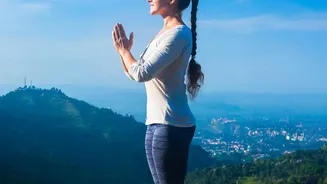

More Than Just Standing Still
In the world of yoga, Tadasana is considered a foundational pose, the blueprint from which all other standing postures emerge. It appears simple, yet this pose is an active and dynamic practice of conscious alignment and body awareness. Think of it not
as passive standing, but as a deliberate act of organising your body with stability and poise, like a mountain rooted firmly into the earth. Its power lies in teaching you how to stand with purpose, creating a line of energy that extends from the soles of your feet to the crown of your head. This practice builds strength, improves posture, and enhances your focus, making it a crucial starting point for beginners and a centering reset for advanced practitioners.
Building Your Foundation From the Ground Up
Proper alignment in Tadasana starts with your feet. Stand with your feet either together with the big toes touching, or hip-width apart for more stability. Spread your toes to widen your base, then let them relax back onto the mat. The key is to distribute your weight evenly across all four corners of each foot: the mound of the big toe, the mound of the pinky toe, and the inner and outer edges of your heel. From this solid base, engage your leg muscles by gently lifting your kneecaps, being careful not to lock your knees. Maintain a micro-bend to keep the joint safe and the muscles active. This creates a strong, stable foundation for the rest of your body.
The Secret: Activating Your Core Gently
The phrase 'engage your core' can be confusing, often leading people to suck in their stomach forcefully. In Tadasana, the goal is a much gentler, more sustainable activation. Imagine subtly drawing the space just below your navel inward and slightly upward. This action engages the transverse abdominis, your deepest core muscle, which acts like a natural corset to support your spine. Another helpful cue is to draw your front ribs down and in, preventing your chest from puffing out and your lower back from arching. This gentle engagement is not about creating rigidity; it’s about finding stability and length through your torso, which supports better posture and breathing.
Aligning the Spine and Upper Body
With your foundation and core set, bring your attention to your pelvis. Aim for a neutral position, avoiding excessively tucking your tailbone under or arching your lower back. Imagine your tailbone dropping lightly toward your heels. Now, stack your shoulders directly over your hips. Many of us hold tension in our shoulders, letting them slump forward. To counter this, actively broaden your collarbones and draw your shoulder blades down your back. Let your arms rest by your sides with your palms facing forward, which encourages this external rotation of the shoulders. Finally, ensure your chin is parallel to the floor, with the crown of your head lifting upward, creating a long, relaxed neck.
Common Misalignments to Avoid
As you practice, watch out for a few common habits that can undermine the pose's benefits. The most frequent is locking the knees, which puts strain on the joints instead of using muscle support. Another is letting your weight shift unevenly onto one foot, or onto the heels or balls of the feet. Many people also tend to over-arch their lower back or, conversely, tuck their pelvis too far under, both of which disrupt the natural curve of the spine. Finally, avoid a 'soldier-like' stiffness. Tadasana should feel active but not tense. Your chest should be open but soft, and your jaw and face should remain relaxed.
Reaping the Benefits of a Strong Mountain
Practicing Tadasana regularly offers profound benefits that extend beyond your yoga mat. It is one of the best poses for improving posture by realigning the spine and strengthening the muscles that support it. This conscious alignment enhances body awareness, teaching you to notice and correct postural habits like slouching throughout your day. The active engagement of the legs and core builds strength and stability, which improves balance and can reduce the risk of falls. Mentally, the stillness and focus required for the pose help calm the mind, reduce stress, and cultivate a sense of grounded confidence.