







A Small Pathfinder with a Giant Job
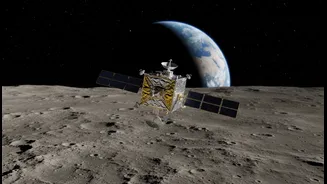
Launched in June 2022, the Cislunar Autonomous Positioning System Technology Operations and Navigation Experiment (CAPSTONE) was never meant to be a flagship mission. Instead, it was a low-cost, 25-kg CubeSat with an outsized responsibility: to act as a scout
for future lunar missions, particularly NASA's Artemis program. Owned and operated by the commercial company Advanced Space, and built by Terran Orbital, CAPSTONE represents a new, more agile way of doing business in space. Its primary goal was to test a unique and untried path around the Moon, reducing the risks for the multi-billion-dollar hardware and human crews set to follow.
Conquering a Revolutionary Lunar Orbit
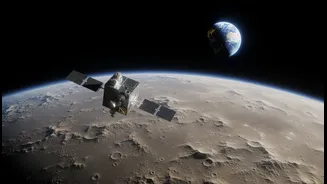
At the heart of CAPSTONE's mission was the near-rectilinear halo orbit (NRHO). Unlike the circular orbits of the Apollo era, the NRHO is a highly elliptical, fuel-efficient path that uses a precise balance point between the gravity of the Earth and the Moon. This special orbit was planned for the Lunar Gateway, the proposed orbiting outpost for astronauts. Before committing a massive station to this path, NASA needed to know if it was as stable as simulations predicted. CAPSTONE became the first spacecraft to ever fly this orbit, successfully inserting itself in November 2022 and proving the trajectory was viable for long-term missions, requiring minimal fuel for station-keeping.
Success Beyond the Primary Mission
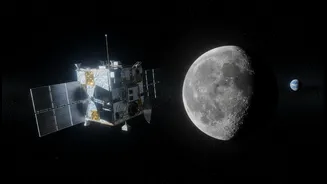
After achieving its main goal in May 2023, NASA extended CAPSTONE's mission by 15 months to turn the tiny satellite into a testbed for next-generation technologies. NASA's activities concluded in June 2026 after the spacecraft successfully demonstrated several groundbreaking capabilities essential for a sustained human presence on the Moon. This included testing autonomous navigation software, called autoNGC, which allowed the spacecraft to determine its own position and direction without constant guidance from Earth. During periods when ground communications were limited, the system used its own camera to navigate by imaging the Earth and Moon, at times outperforming ground-based methods.
Smarter Communications for Deep Space
Another key achievement of the extended mission was testing Delay/Disruption Tolerant Networking (DTN). Deep space communications are often interrupted by long delays or loss of signal. DTN architecture allows a spacecraft to store data when a connection is unavailable and automatically resume the transfer once a link is re-established. CAPSTONE proved this works, ensuring every piece of valuable data made it back to Earth, even with intermittent contact. This technology is crucial for future missions to the Moon and Mars, where constant communication with Earth isn't guaranteed.
What the 'Mission Complete' Update Means
So, what does it mean to 'act on' the update that CAPSTONE's NASA-led mission is complete? For the space industry, this isn't about a stock tip but about absorbing a trove of invaluable, hard-won data. The success of CAPSTONE has de-risked critical components of the Artemis program. Engineers now have real-world data on the stability of the NRHO, validated performance models for propulsion and power systems in deep space, and proven technologies for autonomous navigation and resilient communications. The mission demonstrated that a small, commercially-operated satellite can be upgraded with new software in orbit to become a flexible technology platform, a cost-effective model for future exploration.