




Understanding the 'Desk Damage'
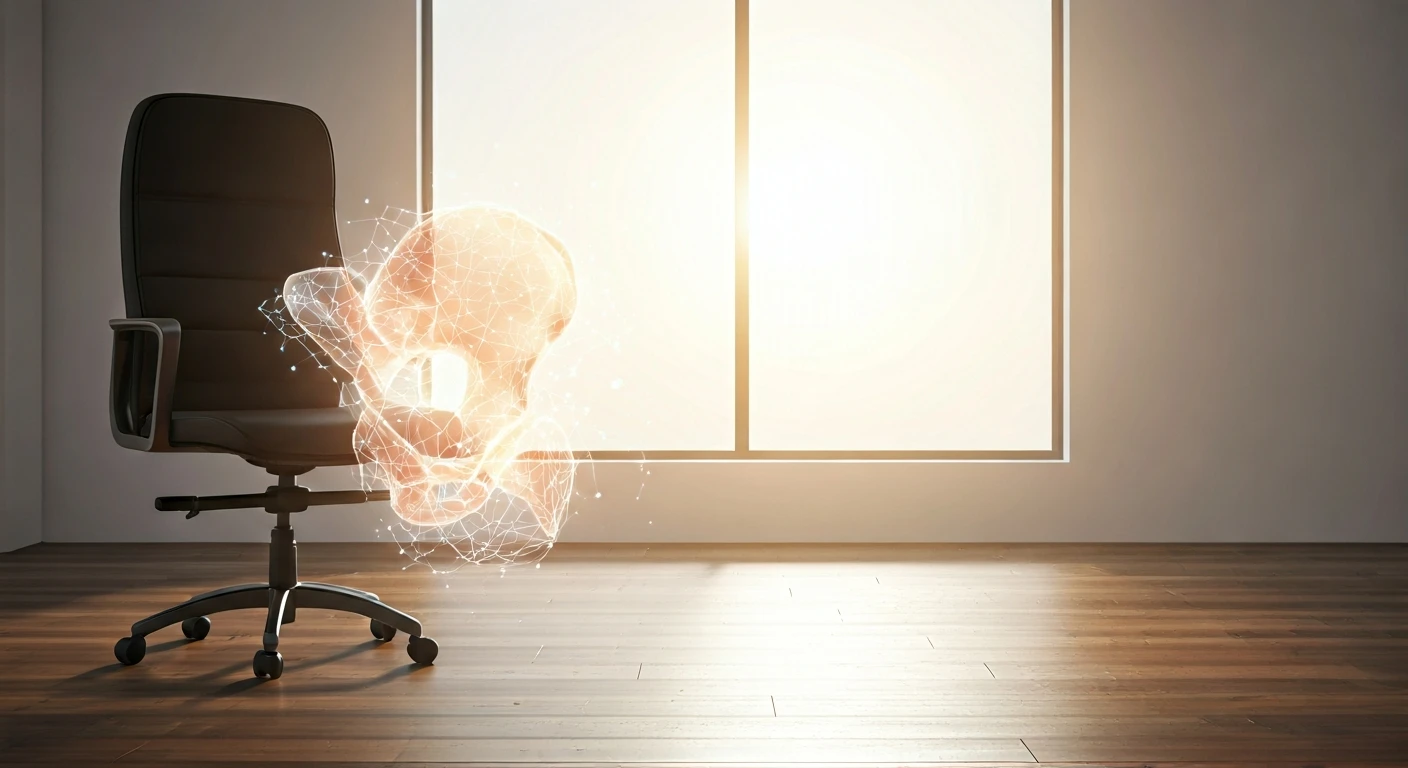
Before we can repair, we must understand the problem. When you sit for hours, your body adapts. Your hip flexors, the muscles at the front of your hips that lift your legs, are held in a shortened position. Over time, they become chronically tight. This
tightness can pull your pelvis forward, leading to a sway in your lower back and contributing to back pain. Simultaneously, your gluteal muscles—your body's largest and most powerful muscle group—are inactive. This 'gluteal amnesia' means they forget how to fire properly, forcing smaller, less suitable muscles to compensate, increasing strain and instability. This combination of tight front-body muscles and weak back-body muscles is the core issue that needs addressing.
Step 1: The Foundational Release
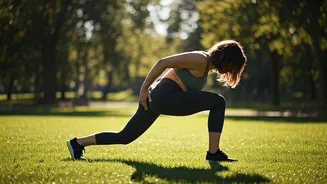
The first step is to gently reintroduce movement and length. The classic Low Lunge, or Anjaneyasana, is a perfect starting point. To perform it, begin on your hands and knees. Step your right foot forward between your hands, ensuring your knee is directly above your ankle. Slide your left knee back until you feel a comfortable stretch in the front of your left hip and thigh. Place your hands on your right thigh for support and lift your chest. Hold for 30 seconds, breathing deeply into the stretch. The key is not to force it, but to allow your body to release. This pose directly counteracts the hip-flexed position of sitting, sending a clear signal to your muscles to lengthen and relax. Remember to repeat on the other side.
Step 2: The Deep External Rotator Stretch
Now we address the deeper muscles around the hip socket. Pigeon Pose, or Eka Pada Rajakapotasana, is unparalleled for this. From a hands-and-knees position, bring your right knee forward towards your right wrist. Angle your right shin so your foot is somewhere near your left hip—it does not need to be parallel to the front of your mat. Extend your left leg straight behind you. If this is too intense, place a folded blanket or a block under your right hip for support. You should feel a stretch deep in your right glute. You can stay upright or fold forward over your front leg. This pose targets the piriformis and other external rotators that often become tight from compensating for weak glutes. Hold for 30-60 seconds, then switch sides.
Step 3: Reclaiming Internal Rotation
Hip mobility is not just about opening up; it’s about a full range of motion. Cow Face Pose, or Gomukhasana (legs only), is excellent for stretching the hips in internal rotation. Sit on the floor with your legs extended. Bend your right knee and place your right foot on the outside of your left hip. Then, bend your left knee and stack it on top of your right, aiming to get your knees in one line. Your feet should be on either side of your hips. This may be very intense. If your knees don't stack, simply sit cross-legged and focus on the intention. You should feel a stretch on the outside of your hips. This movement pattern is the opposite of how we usually sit and is crucial for holistic hip health. Hold for 30 seconds and carefully switch.
Step 4: The Final Re-Activation
After stretching and releasing, we must reactivate the muscles that have gone dormant. Bridge Pose, or Setu Bandhasana, is a simple but powerful way to wake up the glutes. Lie on your back with your knees bent, feet flat on the floor, hip-width apart. Your arms can rest by your sides. Press through your feet and lift your hips off the floor, squeezing your glutes at the top. Avoid arching your back too much; the work should come from your hips and legs. Hold for a moment, then slowly lower down. Perform 10-15 repetitions. This final step retrains your brain-to-muscle connection, reminding your glutes of their primary job: to support your pelvis and power your movement.