




The Two Faces of a Black Hole
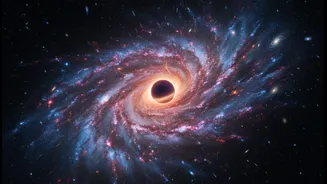
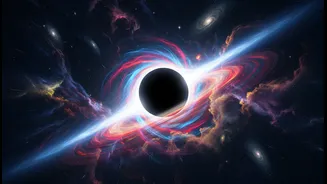
At the heart of most large galaxies, including our own Milky Way, lurks a supermassive black hole. For the most part, these behemoths are in a 'quiescent' or 'dormant' state.. This doesn't mean they are completely inactive. Instead, think of them as simmering.
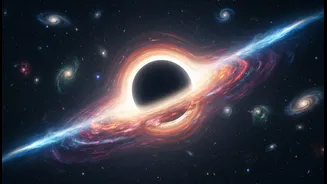
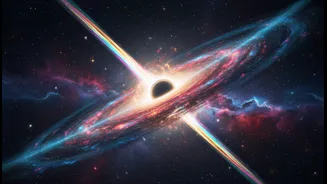
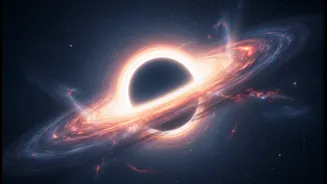
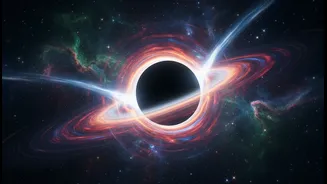
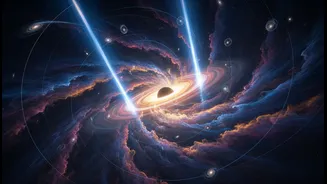
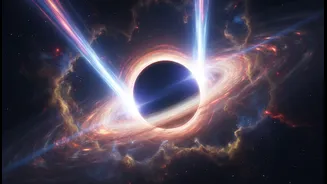
They may pull in wisps of gas or dust that stray too close, causing minor, occasional flickers of radiation, but there's no constant, large-scale feast happening.. Material can orbit a dormant black hole in a stable way for a very long time without being consumed. The other state is 'active'. An active galactic nucleus (AGN), or quasar, is a black hole that is ferociously consuming large amounts of gas and stars.. This process creates an incredibly bright accretion disk—a swirling vortex of superheated material—that can outshine the entire host galaxy..
The Ultimate Wake-Up Call: A Tidal Disruption
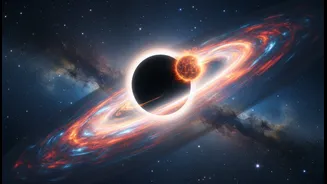
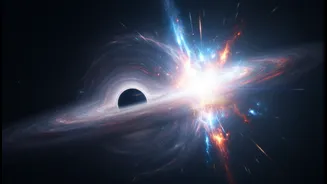
The most dramatic form of 'real-time activation' is a phenomenon known as a Tidal Disruption Event, or TDE.. This occurs when an unlucky star wanders too close to a supermassive black hole. The black hole's immense gravitational pull exerts extreme tidal forces that stretch and tear the star apart in a process gruesomely nicknamed 'spaghettification'.. Some of this stellar debris is flung out into space, but a significant portion is captured into an orbit around the black hole, forming a new, temporary, and incredibly luminous accretion disk.. This sudden flare of light, brighter than almost any supernova, is the tell-tale sign that a dormant black hole has violently awoken..
Searching for the Flare
Distinguishing the steady, low-level activity of a quiescent black hole from the sudden, brilliant flare of a TDE requires a multi-pronged approach. The key difference is the nature of the light signal. A TDE produces a massive and sudden burst of energy across the entire electromagnetic spectrum, from high-energy X-rays and ultraviolet light to visible light and radio waves.. Astronomers use powerful survey telescopes that scan the sky repeatedly, looking for these transient events—sources of light that appear, brighten dramatically, and then fade over months or years.. It's this specific light curve—a sharp rise in brightness followed by a gradual decline as the stellar material is consumed—that sets a TDE apart from other cosmic explosions..
The Cosmic Detective Toolkit
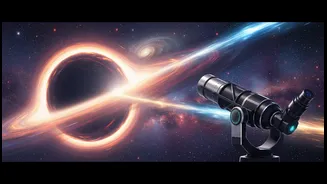
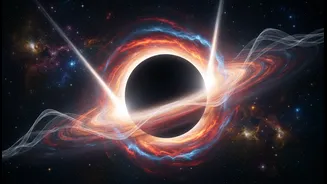
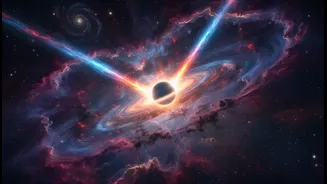
Confirming a TDE and ruling out impostors like supernovae requires a coordinated effort using multiple instruments. This is the core of multi-messenger astronomy.. Once a potential flare is detected by an optical survey telescope, astronomers will quickly point other telescopes at the source. X-ray observatories like NASA's Chandra X-ray Observatory are crucial because the intense heat of the newly formed accretion disk produces a strong X-ray signature.. Radio telescopes, in turn, can detect outflows or jets of material that are sometimes launched during these events.. By combining data from different wavelengths, astronomers can build a complete picture of the event, confirming its origin. Spectroscopy, which breaks down light into its constituent colors, can also reveal the chemical composition of the shredded star, providing further evidence that it was indeed a TDE..
Why We Watch for Waking Giants
Studying these activation events is more than just cosmic disaster-watching. Since black holes themselves are invisible, TDEs provide a rare opportunity to illuminate their immediate surroundings.. The way a star is torn apart and consumed gives scientists a wealth of information about the black hole's mass and even its spin.. These events are rare, happening only about once every 10,000 to 100,000 years in any given galaxy.. However, new powerful observatories are expected to detect hundreds of them in the coming years.. Each new detection helps astronomers test the limits of general relativity and better understand the powerful role these giants play in the evolution of galaxies. It’s by watching a black hole eat that we learn the most about its nature.