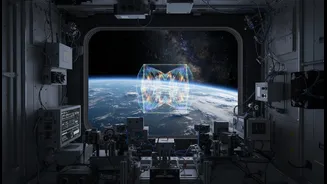




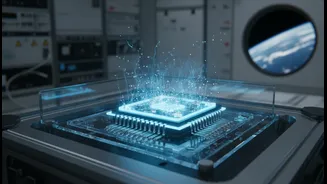
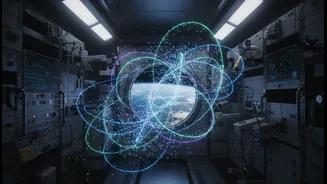
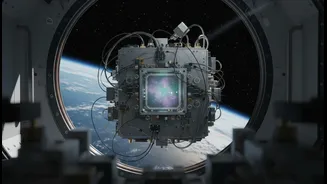


What Is the Cold Atom Lab?
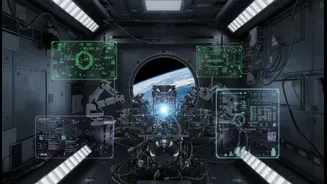
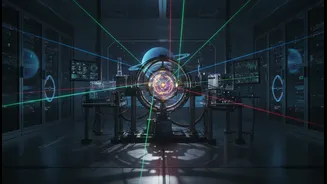
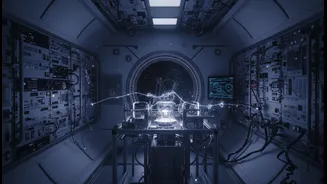
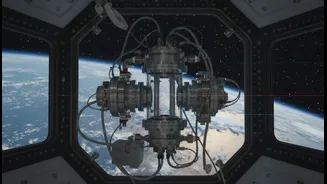
The Cold Atom Lab (CAL) is a NASA facility operating on the ISS since 2018. Managed remotely from Earth by the Jet Propulsion Laboratory, its purpose is to study the behaviour of atoms at temperatures colder than anything found in nature—just a fraction
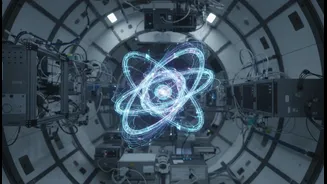
of a degree above absolute zero, or -273.15°C. At these extreme temperatures, atoms slow down dramatically and can enter a bizarre fifth state of matter called a Bose-Einstein Condensate (BEC). In a BEC, atoms lose their individual identities and behave like a single, massive quantum wave, allowing scientists to observe quantum phenomena on a macroscopic scale. Performing these experiments in the microgravity of space is crucial, as it allows these delicate condensates to be observed for much longer periods—over a second, compared to mere milliseconds on Earth—before gravity causes them to collapse.
A Major Quantum Leap Forward
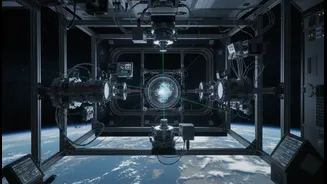
In mid-2026, astronauts on the ISS completed the fourth major upgrade to the lab, significantly enhancing its capabilities. New hardware, which arrived at the station in April 2026, includes a redesigned magnetic trap for containing the atom clouds and improved electronics. This allows researchers to create Bose-Einstein Condensates that are five times larger than before and provides greater flexibility in manipulating their shape. Scientists can now form the ultracold gas into different shapes, such as bubbles, giving them new ways to investigate the fundamental properties of matter. The upgrade also includes improved atom sources and better measurement tools, essentially making the coldest spot in the universe even more effective at probing the quantum realm.
The Promise of Atom Interferometry
One of the most exciting techniques advanced by the Cold Atom Lab is atom interferometry. This method uses the wave-like nature of atoms to make extraordinarily precise measurements. An atom interferometer works by splitting an atom wave in two and then recombining it. The way the waves interfere with each other upon recombination is incredibly sensitive to external forces like gravity. In the stable microgravity environment of the ISS, these measurements can be far more precise than on the ground. This capability turns the lab into a powerful quantum sensor. Such technology could be used to test fundamental laws of physics, like Einstein's theory of general relativity, with unprecedented accuracy and even aid in the search for mysterious cosmic phenomena like dark matter and dark energy.
From Space Research to Earth-Based Technology
While the research conducted in the Cold Atom Lab seems abstract, its potential applications are vast and could have a significant impact on future technology back on Earth. The development of ultra-precise quantum sensors is a major goal. This technology could lead to navigation systems far more accurate than current GPS, capable of guiding spacecraft or operating on Earth without needing to connect to an external signal. It could also result in 'gravitational cameras' that can map what lies beneath the Earth's surface—useful for civil engineering, mineral exploration, or tracking changes in ice sheets and water resources for climate research. By proving that these delicate quantum instruments can operate reliably in the harsh environment of space, the Cold Atom Lab is paving the way for a new generation of quantum technologies.