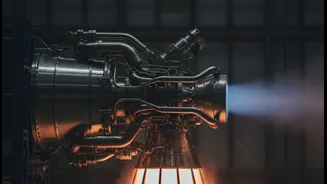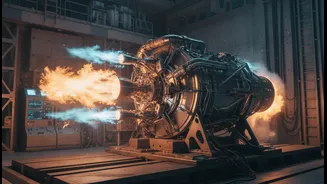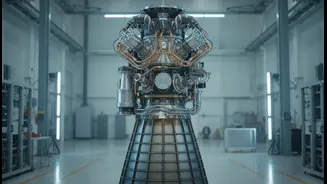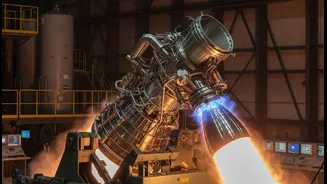






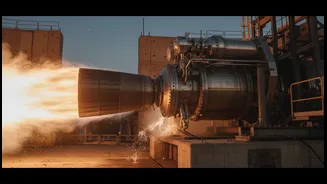


What is a Semicryogenic Engine?
Think of a rocket engine as a controlled explosion. The fuel and an oxidizer combine and ignite to create immense thrust. ISRO's current heavy-lifter, the LVM3, uses a mix of technologies: solid propellant strap-on boosters, a liquid-fuel core stage,
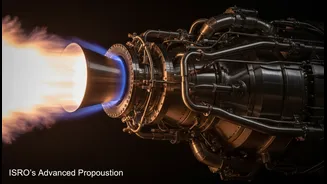
and a cryogenic upper stage. The cryogenic stage, which uses super-cooled liquid hydrogen and liquid oxygen, is highly efficient but expensive and complex to handle. A semicryogenic engine offers a powerful and practical middle path. ISRO's SCE-200 engine uses liquid oxygen, which is cryogenic, but pairs it with a highly refined kerosene called Isrosene. This fuel is a liquid at normal room temperatures, making it far easier and cheaper to store and manage than liquid hydrogen, which must be kept below -253°C.
The Key Benefits: More Power, Less Cost
The primary advantage of mastering semicryogenic technology is a massive boost in lifting power. The SCE-200 is designed to produce 200 tonnes of thrust. The plan is to replace the LVM3's current core stage, which uses two Vikas engines, with a single, more powerful stage powered by one SCE-200 engine. This upgrade will significantly increase the rocket's payload capacity, allowing India to launch heavier communication satellites, more complex deep-space missions, and potentially larger components for future space stations. Another major benefit is cost. Kerosene is significantly cheaper than liquid hydrogen. It is also denser, meaning more fuel can be stored in the same volume, leading to more efficient rocket designs. The simplified storage and handling requirements also reduce ground-side operational costs, making each launch more economical. This is crucial for competing in the lucrative global satellite launch market. Furthermore, Isrosene is a cleaner-burning fuel compared to the propellants used in the solid boosters, making it a more environmentally-conscious choice.
Navigating the Risks and Challenges
Developing this technology is not without its hurdles. Semicryogenic engines, particularly the oxidizer-rich staged combustion cycle used in the SCE-200, are incredibly complex pieces of machinery. Ensuring the stable and controlled combustion of propellants under extreme pressures and temperatures is a major engineering challenge that requires extensive testing. Failures during development are common globally, and each test, whether a success or a setback, provides critical data. In a recent milestone test in late June 2026, ISRO successfully fired the engine's power-head assembly, achieving 175 tonnes of thrust—88% of its target. While a significant achievement, it highlights the iterative nature of development. Handling the propellants also carries risk. While Isrosene is manageable, liquid oxygen is still a cryogenic fluid that must be stored and handled with extreme care. The entire system, from the turbopumps to the injectors, must perform flawlessly for a successful launch.
The Road Ahead for ISRO
The successful power-head test is a major confidence booster, but several steps remain. The immediate goal is to conduct a full-duration hot fire test of the complete SCE-200 engine, running it at its full 200-tonne thrust capacity for the same amount of time it would fire during an actual flight. Once the engine itself is qualified, it must be integrated with its fuel tanks and associated systems to create the new core stage, known as the SC120. This entire stage will then undergo another series of rigorous ground tests before it is ready for its maiden flight. The ultimate goal is not just to upgrade the existing LVM3 rocket but also to use this powerful engine as the backbone of ISRO's Next Generation Launch Vehicle (NGLV). The NGLV is envisioned as a modular and reusable rocket family that will eventually replace the PSLV and LVM3, making India a truly dominant and self-reliant force in space launch services.