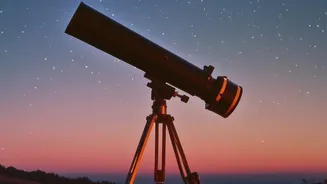




November's crisp, post-monsoon skies offer a perfect window for cosmic exploration. This month, several planets put on a show, and a few meteor showers are set to peak. Here's your guide to escaping the city lights for a celestial spectacle.
The Celestial Line-up for November 2026
November is
an exciting month for skywatchers. Saturn is perfectly visible in the evening, while a spectacular alignment of four planets — Mercury, Venus, Jupiter, and Mars — will be visible in the pre-dawn sky from mid-November. The highlight will be a close conjunction of Mars and Jupiter around November 16, where they will appear like a bright double star. Uranus reaches opposition on November 25, its brightest for the year, making it an excellent time to spot the distant ice giant with binoculars or a telescope. The month also hosts two meteor showers: the Taurids (peaking November 5 and 12) and the Leonids (peaking November 17-18). The new moon on November 9 provides the darkest skies, ideal for deep-sky viewing.
Near Delhi: Sariska & The Aravallis
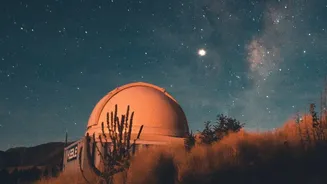
For Delhiites, the Aravalli hills provide the quickest escape from the city's severe light pollution. Locations like Damdama Lake and Sohna offer decent skies for casual stargazing. However, for a more dedicated experience, Astroport Sariska, located near the Sariska Tiger Reserve, is a purpose-built astronomy resort. Situated about 200 km from Delhi, its location in the Aravallis ensures minimal light interference, making it a prime spot for observing fainter objects. It offers guided sessions with professional telescopes, perfect for both beginners and seasoned astronomers looking to make the most of November's clear nights.
Near Mumbai & Pune: The Sahyadri Escapes
The Sahyadri mountain range is a haven for stargazers from Mumbai and Pune. Locations like Pawna Lake, Mulshi Dam, and Kamshet are popular for their relatively dark skies and open horizons, especially over the water. For those seeking even darker skies, Velhe, about 60 km from Pune, is considered one of the best spots in Maharashtra. Campsites in Velhe and Lonavala often host specific astronomy events, providing telescopes and expert guidance to help visitors navigate the cosmos and spot planets like Saturn in the evening. The period from October to February is ideal, as the post-monsoon air is crisp and clear.
Near Bengaluru: Coorg & Denkanikottai
Bengaluru's active astronomy community often heads towards a few key locations. For a serious dark_sky experience, the area around Denkanikottai in Tamil Nadu, about 80 km away, is the closest and darkest accessible site. Further afield, the hills of Coorg (Kodagu) offer some of the best skies in Southern India, with many homestays and resorts providing excellent, light_free vantage points. At an altitude of over 900 metres, Coorg is ideal for viewing the pre_dawn planetary alignment in a stunning natural setting. Locations like Ramanagara and Savandurga are also popular for shorter trips.
Near Chennai: Yelagiri & The Jawadhu Hills
For Chennai residents, the hill stations of the Eastern Ghats are the best bet. Yelagiri is often recommended as the most accessible weekend destination for beginners, offering a significant improvement over city skies. For more dedicated observers, the Jawadhu Hills are a prime destination, home to the Vainu Bappu Observatory in Kavalur. This area provides darker, more pristine conditions suitable for telescope observation of deep_sky objects and planets like Uranus. The period after the monsoon, from October onwards, provides the best viewing conditions.
Near Hyderabad: Ananthagiri Hills & Koil Sagar
Hyderabad's surrounding plateaus and forests offer several promising locations. Ananthagiri Hills, about 80 km away, is a popular spot for its elevation and minimal light pollution, making it great for stargazing and astrophotography. For a lakeside experience, Koil Sagar Reservoir, about a three_hour drive away, is an excellent site for camping under the stars. Closer to the city, Shamirpet Lake and Ameenpur Lake also provide darker skies than the city centre, suitable for viewing bright planets and constellations with binoculars or a small telescope.
Near Kolkata: The Rural Outskirts
Finding truly dark skies near Kolkata is challenging due to the region's population density and widespread light pollution. However, heading towards the rural areas of Purulia can yield rewarding views. Sky_watching groups have identified locations like Bhalopahar in a 'Bortle 4' zone, which is significantly darker than the city. Coastal areas like Mandarmani, which are less developed than Digha, can also offer clearer skies on moonless nights. While not pristine, these spots provide the best local opportunities to escape the city's glow and catch a glimpse of the November sky's celestial events.