





A Celestial Meeting in the Evening Sky
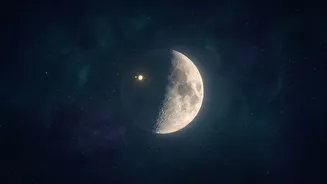
On the evening of October 18, 2026, Saturn and a waxing gibbous Moon will be in a close celestial rendezvous, an event known as a conjunction. They will appear as two of the brightest objects in the sky, making them easy to spot. For observers, this provides
a wonderful chance to locate the sixth planet from the Sun using the Moon as a convenient signpost. While the exact time of the closest approach may vary by a few hours depending on your location, the pair will be a commanding presence in the sky throughout the night.
Start With Just Your Eyes
The best news for absolute beginners is that you don’t need any special equipment to see this event. Both the Moon and Saturn are easily visible to the naked eye. To find them, simply look for the bright Moon, and the nearby steady, yellowish-white 'star' will be Saturn. Unlike true stars that twinkle due to atmospheric turbulence, planets like Saturn typically shine with a more stable light. This simple observation is a rewarding experience in itself and connects you directly with the grand scale of our solar system.
Bring the View Closer With Binoculars
To enhance your view, a simple pair of binoculars can make a significant difference. A standard pair, such as 7x50 or 10x50 models (where the first number is magnification and the second is the lens diameter in millimetres), will provide a much more detailed look. While binoculars won't be powerful enough to clearly resolve Saturn’s famous rings, they may reveal the planet as a slightly elongated or oval-shaped disc. They will also offer breathtaking views of the Moon’s craters, seas, and mountain ranges along the terminator—the line dividing its light and dark sides.
Unlock the Rings With a Telescope
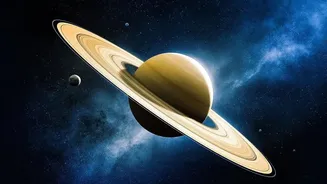
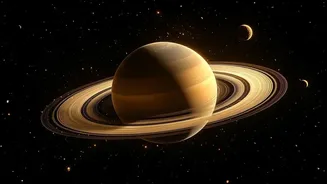
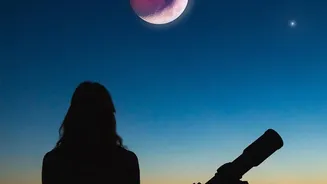
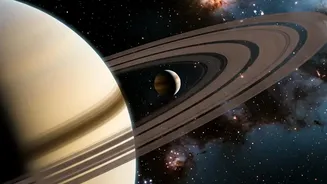
To witness the sight that has captivated astronomers for centuries—Saturn's magnificent rings—you will need a telescope. Fortunately, you don't need a professional-grade instrument. A small beginner's telescope with at least 25x magnification can start to reveal the rings as distinct from the planet itself. For a clearer view, a telescope with an aperture (the diameter of its main lens or mirror) of at least 60mm for a refractor or 4 inches for a reflector is recommended. These instruments will gather enough light to not only show the rings clearly but also potentially reveal the gap between the rings and the planet, and maybe even its largest moon, Titan, appearing as a tiny star-like point of light nearby.
Tips for an Unforgettable Viewing Experience
Regardless of your equipment, your viewing experience can be improved with a few simple strategies. First, try to find a location away from bright city lights. Light pollution can wash out fainter objects and reduce contrast. Second, give your eyes time to adjust to the darkness. It takes about 20-30 minutes for your eyes to become fully dark-adapted, which will allow you to see much more detail. If you need to use a flashlight, use one with a red light, as red light is less detrimental to your night vision. Finally, consider using a stargazing app on your smartphone to help you confirm Saturn's position and identify other celestial objects that may be visible nearby.