


A New Window Into Distant Skies
For decades, finding planets outside our solar system—known as exoplanets—was a monumental achievement. We could find them and measure their size and mass, but understanding what they were truly like remained largely out of reach. The James Webb Space
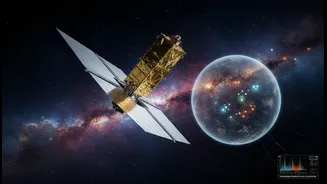
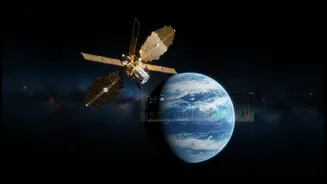
Telescope has changed the game. As a successor to the Hubble Space Telescope, JWST is designed to see the universe in infrared light, which is crucial for studying distant, cooler objects. This capability allows it to do something remarkable: analyze the chemical makeup of exoplanet atmospheres. The primary method is called transmission spectroscopy. As an exoplanet passes in front of its host star from our perspective, a tiny fraction of the starlight filters through the planet's atmosphere. By capturing this light, JWST can see which 'colors' (or wavelengths) are missing, absorbed by the gases in that alien air.
Reading a Planet's Chemical Barcode
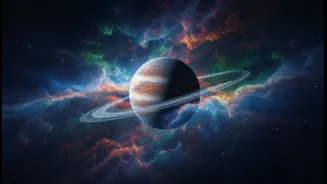
Every gas absorbs light at a unique set of wavelengths, creating a chemical 'fingerprint' or 'barcode'. By analyzing the starlight that has passed through an exoplanet's atmosphere, scientists can identify the molecules present. This has led to a flurry of discoveries. On a 'hot Saturn' named WASP-39 b, Webb found the first concrete evidence of photochemistry on an exoplanet by detecting sulfur dioxide, a molecule created by the star's high-energy light interacting with the atmosphere. On another world, WASP-96 b, it delivered the clearest-ever signature of water vapor in an exoplanet's atmosphere. These observations are not just about cataloging chemicals; they provide clues about a planet's climate, weather patterns, and even its formation history. JWST can even detect how atmospheres are evolving, once witnessing a planet named WASP-107b dramatically shedding its atmosphere as it's blasted by its star's heat.
The Hunt for Biosignatures
The most tantalizing goal is the search for biosignatures—gases that indicate the presence of life. On Earth, life has completely transformed our atmosphere, filling it with gases like oxygen that wouldn't exist in such high quantities otherwise. A key target for JWST is K2-18 b, a 'super-Earth' located 120 light-years away in its star's habitable zone, where conditions might be right for liquid water. Webb observations of this world confirmed the presence of methane and carbon dioxide. This combination, along with a lack of ammonia, supports the theory that K2-18 b could be a 'Hycean' world—a planet with a water ocean under a hydrogen-rich atmosphere. These findings alone are significant, but it was another potential discovery that truly electrified the scientific community.
A Tantalizing Hint of Life?
In the data from K2-18 b, astronomers found a possible trace of dimethyl sulfide (DMS). This is a profound finding because, on Earth, DMS is only known to be produced by life, primarily by marine phytoplankton. The potential detection of a molecule so strongly linked to biology marks one of the most significant developments in the search for extraterrestrial life. However, scientists are exercising extreme caution. The DMS signal is not yet definitive and requires further observation to be confirmed. Furthermore, even if the gas is present, we don't know for certain that there isn't some unknown non-biological chemical process that could produce it on a world so different from our own. But even as a possibility, it represents a major milestone, guiding where astronomers will focus their efforts next.
The Dawn of a New Science
The work of decoding alien atmospheres is just beginning, and it's filled with challenges. The signals are incredibly faint, and interpreting them requires complex models and ruling out non-biological explanations for any potential biosignatures. No single gas detection can be considered proof of life. Scientists look for a combination of gases that are out of chemical balance—a state of disequilibrium that suggests an active process, like life, is constantly replenishing them. The James Webb Space Telescope is our first tool powerful enough to conduct this type of investigation on planets orbiting other stars. While it has not yet discovered an atmosphere around a truly Earth-sized rocky planet, its early results on larger worlds have exceeded expectations. It is writing a new chapter in astronomy, moving the study of exoplanets from detection to true characterization.