


The Universe in a Data Firehose
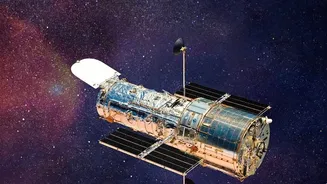
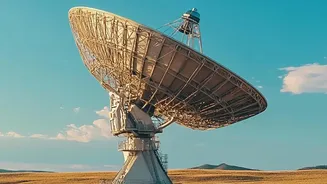
Today’s astronomy is a big data problem. Telescopes like the Hubble and James Webb Space Telescope have been observing the cosmos for years, creating immense archives of images and measurements. But this is just the beginning. The Vera C. Rubin Observatory
in Chile, which began its decade-long survey in 2026, is set to generate around 20 terabytes of data every single night. It is expected to issue as many as 10 million alerts for 'transient' events—objects that change or move—in a single session. No team of human scientists, no matter how dedicated, could ever manually inspect this cosmic firehose of information. Without a new approach, countless discoveries would remain buried in the digital noise, unseen and unstudied.
A Digital Sieve for the Cosmos
This is where artificial intelligence comes in. Scientists are now deploying sophisticated machine learning algorithms to act as a powerful digital sieve. These AI models are trained on vast datasets of known celestial objects. By learning to recognize the patterns of a 'normal' star, galaxy, or nebula, they become exceptionally good at spotting the outliers—the anomalies that don't fit. In January 2026, a European Space Agency team revealed an AI called AnomalyMatch, which they used to scan 35 years of archived Hubble data. In just two and a half days, the AI sorted through nearly 100 million image cutouts, a task that would be impossible for humans. This ability to rapidly flag the unusual is what makes AI an indispensable tool for discovery.
A Gallery of Weird and Wonderful Finds
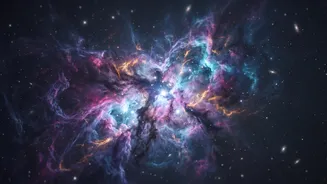
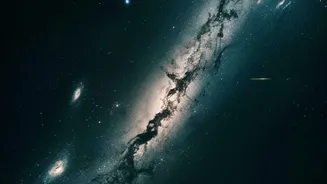
So, what are these AI systems finding? The AnomalyMatch project alone flagged over 1,300 strange objects, more than 800 of which had never been documented by scientists. The discoveries range from the beautiful to the bizarre. The AI identified numerous gravitational lenses, where the gravity of a massive foreground galaxy bends and magnifies the light from a more distant one into eerie arcs and rings. It also found 'jellyfish galaxies' with long, trailing tentacles of gas being stripped away, and even planet-forming disks viewed edge-on that have been whimsically described as looking like cosmic 'hamburgers'. Perhaps most excitingly, some objects defied any existing classification, presenting astronomers with entirely new puzzles to solve.
More Than Just a Robot Observer
It’s important to understand that AI is not replacing astronomers. Instead, it’s creating a powerful partnership. The AI handles the monumental task of initial filtering, but its findings are then handed over to human experts for the crucial steps of verification and interpretation. Scientists examine the flagged anomalies to determine if they are genuine discoveries or merely data glitches. They then apply their knowledge to understand the physics behind these strange objects. In this sense, AI acts as a research assistant with superhuman pattern-recognition skills, freeing up valuable human time for deeper analysis and creative thinking. As new observatories come online, this human-machine collaboration will become the standard operating procedure for making sense of the universe.