






The solar system can be a violent place. Imagine a comet, a frozen traveller from the outer darkness, venturing too close to a giant planet like Jupiter. Suddenly, it shatters into a trail of glittering debris. This isn't science fiction.
The Cosmic Danger Zone
At the heart
of this phenomenon is a concept called the Roche limit. First calculated by French astronomer Édouard Roche in 1848, it defines an invisible boundary around any large celestial body, like a planet or a star. Think of it as a cosmic danger zone. When a smaller object, such as a comet or moon held together primarily by its own gravity, crosses this line, the gravitational pull of the larger body becomes overwhelming. The larger planet’s gravity pulls more strongly on the near side of the comet than it does on the far side. This difference in force, known as a tidal force, effectively stretches the smaller object until it can no longer hold itself together.
A Comet's Final Moments
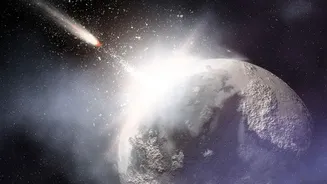
Comets are often described as 'dirty snowballs'—loose collections of ice, dust, and small rocky particles. They aren't solid, monolithic rocks, which makes them particularly vulnerable to tidal forces. For a body held together by its own weak gravity, like a rubble-pile asteroid or a comet, crossing the Roche limit is a catastrophic event. The tidal 'stretch' overcomes the comet's own gravitational glue, and it is torn apart. This isn't a slow erosion; it's a relatively sudden and complete disintegration into numerous smaller fragments. The once-singular comet becomes a stream of debris, a 'string of pearls' trailing through space.
From Debris to a Ring
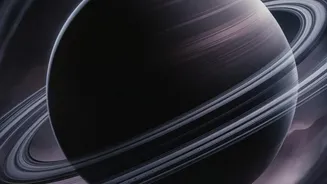
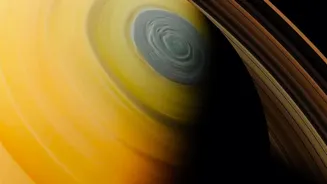
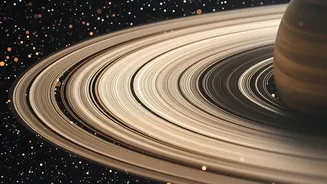
Once the comet shatters, its fragments don't just fly off in random directions. They largely continue along the original orbital path. However, the pieces that were on the side closer to the planet are now in a slightly lower, faster orbit, while the pieces from the far side are in a slightly higher, slower orbit. Over time, this difference in speed causes the debris to spread out. The faster inner particles lap the slower outer ones, and the entire stream of fragments disperses along the orbital path, forming a continuous ring of material. Inside the Roche limit, the planet’s tidal forces also prevent these small particles from clumping back together to form a new moon, ensuring they remain as a ring.
A Famous Real-World Example
The most famous observation of this process occurred in July 1992, when Comet Shoemaker-Levy 9 passed too close to Jupiter. It crossed well inside Jupiter’s Roche limit, and the planet's immense tidal forces ripped the comet into at least 21 distinct fragments. These pieces were then observed as a spectacular chain before they all spectacularly collided with Jupiter two years later, in July 1994. This event provided the first direct observation of a celestial body's tidal disruption and gave astronomers a real-world laboratory to study the physics of ring formation and planetary impacts. The dark scars left in Jupiter's atmosphere were visible for months, a stark reminder of the power at play.