







The Monsoon's Mid-Season Stumble
The lifeline of Indian agriculture, the southwest monsoon, appears to be losing momentum. After a poor start in June, a July revival brought some relief, but August has been marked by inconsistency. As of mid-August, the all-India rainfall deficit remains
stuck at around 12% below the long-period average. The India Meteorological Department (IMD) had earlier forecasted a below-normal second half of the monsoon season, and recent developments seem to align with this prediction. While a new weather system in the Bay of Bengal is expected to bring rain to eastern and central India, its distribution and intensity will be critical. Experts note that the seasonal total often masks the real story; it is the distribution of rainfall during critical growth phases that truly matters for agriculture.
Crucial Period for Key Crops
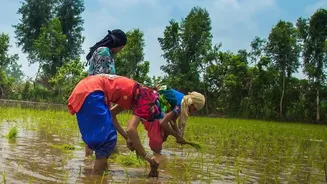
The timing of this rainfall deficit is what worries agricultural experts the most. The sowing season for Kharif crops has largely concluded, with overall acreage down about 2% compared to last year as of August 14. Key crops like rice, pulses, and oilseeds are now in their vegetative and reproductive growth stages, where adequate soil moisture is essential for determining the final yield. Rice, the main Kharif crop, has seen its acreage decline by about 3.7%. Soybean, another critical crop, is particularly at risk from moisture stress, which can severely impact pod formation and grain filling. Similarly, pulses like tur (arhar) and maize have also seen a reduction in sown area. With little scope left for further planting, the fate of the harvest now depends entirely on crop yields, which are directly tied to rainfall over the next few weeks.
An Uneven National Picture
The rainfall deficit is not uniform across the country, creating a patchwork of distress and relief. Some regions have experienced floods, while others are grappling with prolonged dry spells. The sharpest deficits are in East and Northeast India, which are 27% below normal. Several major agricultural states are facing significant shortfalls: Bihar is down 39%, parts of Uttar Pradesh and Punjab are down by over 30%, and key southern states like Karnataka and Kerala are also facing deficits of over 20%. According to one analysis, 40 of the top 50 rice-producing districts in the country are running a rainfall deficit. Satellite imagery reveals a worrying trend, with assessments as of August 12 showing that as much as 64% of India's agricultural area is experiencing some level of drought stress.
The Ripple Effect on the Economy
A shortfall in Kharif production has consequences that extend far beyond the farm gate. The agricultural sector is a cornerstone of the Indian economy, providing livelihoods for a vast portion of the population. A poor harvest can depress rural incomes, dampen demand, and fuel food inflation, which directly impacts every household's budget. With crops like pulses and oilseeds under pressure, there are concerns about a potential rise in the prices of daily essentials. The government has set ambitious production targets for the season, including 176.16 million tonnes of foodgrains, but a weak monsoon could put these goals in jeopardy. The performance of the monsoon in the coming weeks will therefore be a key factor influencing the Reserve Bank of India's stance on inflation and interest rates.
Eyes on the Skies and Policy
All eyes are now on the sky, hoping for a late-season revival of the monsoon to salvage the crops. A fresh low-pressure area formed over the Bay of Bengal on August 16, concentrating into a depression by August 17, brings hope for renewed rainfall across eastern and central India. Farmers and policymakers are anxiously tracking its movement. In the meantime, government agencies are issuing advisories to farmers, promoting climate-resilient practices to mitigate the impact of the dry spell. If yields are significantly impacted, the government may need to roll out contingency plans, including support for affected farmers and measures to manage food supply and control prices. The coming fortnight is critical; it will determine whether the nation reaps a healthy harvest or braces for a period of agricultural and economic stress.