


Beauty and the Beast
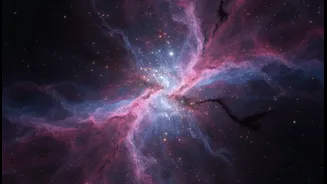
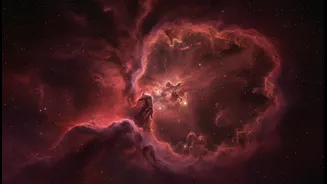
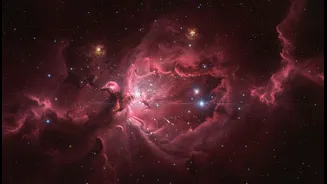
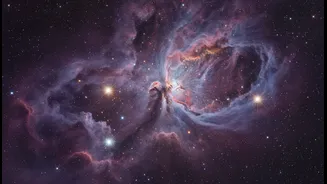
Take the iconic 'Pillars of Creation' in the Eagle Nebula. First made famous by the Hubble Space Telescope in 1995, these towering columns of gas and dust look majestic and peaceful. They appear to be cradling the next generation of stars. In reality,
these pillars are being relentlessly sandblasted and eroded by the intense radiation and powerful stellar winds from a nearby cluster of young, massive stars. The very forces that make them glow are also actively destroying them. This duality is at the heart of star formation. The process is a constant battle between gravity pulling material together and various other forces pushing it apart. It’s far from the simple, quiet collapse often imagined.
The Turbulent Recipe
So, what makes star birth so messy? The ingredients themselves are simple: vast clouds of mostly hydrogen gas and dust. Gravity is the main driver, slowly pulling this material into denser clumps. If gravity were the only force at play, star formation would be incredibly efficient, turning huge amounts of gas into stars very quickly. But observations show this isn't the case; star formation is remarkably inefficient, with only a small percentage of a cloud's gas ever becoming part of a star. The main culprits are turbulence and magnetic fields. The gas in a nebula is not still; it's a swirling, chaotic environment full of eddies and random motions that resist gravity's pull, preventing large-scale collapse.
Magnetic Fields and Infant Tantrums
Magnetic fields thread through these gas clouds, adding another layer of complexity. The fields can act like a support structure, slowing down or preventing the gravitational collapse of gas clouds. Yet, once a dense core does manage to form and collapse into a protostar—the hot, dense baby version of a star—the chaos intensifies. As this protostar pulls in more material, it doesn't just grow quietly. The combination of its rapid rotation and powerful magnetic fields launches colossal jets of gas from its poles, travelling at hundreds of kilometres per second. These jets, or 'outflows,' slam into the surrounding nebula, blowing away the very gas that could have formed more stars or fed the protostar's own growth. These stellar tantrums are a crucial, if messy, part of regulating the process.
A Cycle of Creative Destruction
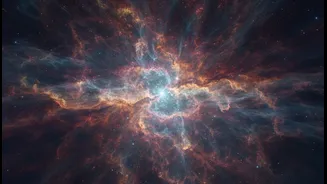
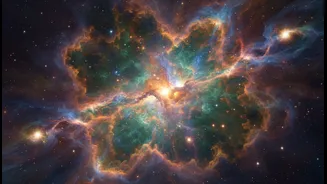
The feedback from newborn stars is a primary source of the mess. The most massive young stars emit scorching radiation and fierce stellar winds that carve out huge cavities in their parent nebula and disrupt nearby star-forming regions. This can either halt further star creation or, in some cases, compress nearby gas and trigger a new wave of it. And the cycle doesn't end there. When these massive stars reach the end of their short lives, they explode as supernovae, unleashing even more energy and heavy elements into the cosmos. This violent explosion sends shockwaves through space, which can compress distant clouds of gas, initiating the entire messy process of star birth all over again. In this way, the destructive forces are also creative ones.