


The Target: What Are Super-Earths?
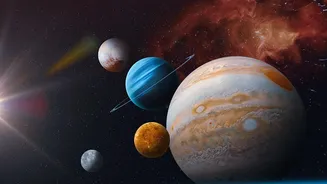
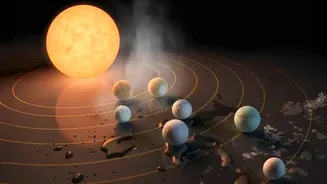
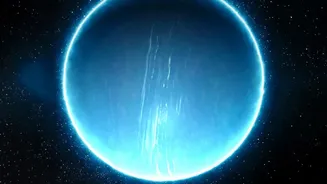
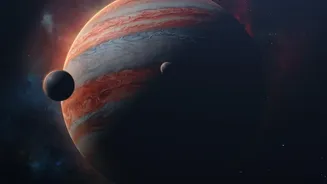
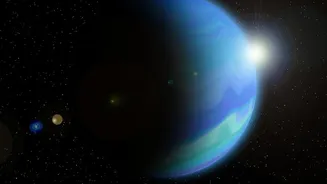
Before we dive into the 'how,' let's understand the 'what.' Super-Earths are a class of exoplanet unlike anything in our own solar system. They are planets more massive than Earth but lighter than our ice giants like Neptune. This category covers a wide
range of possibilities: some could be rocky worlds larger than our own, while others might be dense, gassy planets known as 'mini-Neptunes' or even water worlds. The term 'super-Earth' refers only to a planet's size and mass, not whether it's habitable. What makes them so compelling is their sheer abundance; they are one of the most common types of planets discovered in our galaxy so far, even though our solar system curiously lacks one. Their size and mass mean they have a better chance of holding onto an atmosphere, which is the key to everything the James Webb Space Telescope (JWST) wants to find.
The Technique: A Cosmic Shadow Play
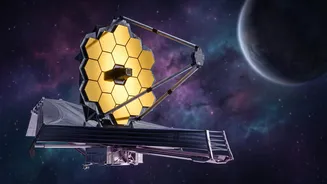
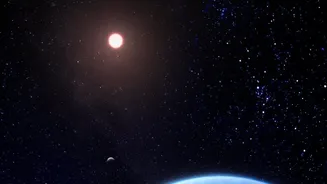
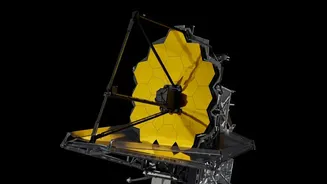
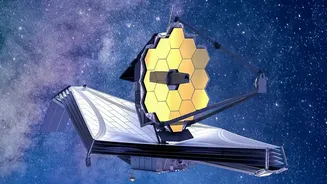
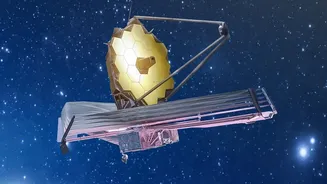
The primary method JWST uses is called transmission spectroscopy. It’s a beautifully simple concept that relies on a bit of cosmic alignment. Scientists wait for an exoplanet to pass in front of its host star from our point of view—an event called a 'transit'. As the planet transits, a tiny fraction of the star's light filters through the planet's atmosphere. That light then travels across the vastness of space until it is collected by Webb's giant mirror. Different chemical elements and molecules in the planet's atmosphere absorb specific wavelengths, or colours, of light. This process leaves behind a unique chemical fingerprint in the starlight. By analyzing which colours of light are missing, astronomers can deduce precisely what gases are present in that alien sky, from methane to carbon dioxide, and most excitingly, water vapour.
The Tools: Webb’s Powerful Infrared Eyes
This is where JWST’s advanced technology truly shines. The telescope is equipped with a suite of incredibly sensitive instruments designed to analyze infrared light—a range of light invisible to the human eye but perfect for detecting the heat and chemical signatures of distant objects. For studying exoplanet atmospheres, two key instruments are the Near-Infrared Imager and Slitless Spectrograph (NIRISS) and the Near-Infrared Spectrograph (NIRSpec). NIRISS is purpose-built for exoplanet spectroscopy, capable of capturing a broad spectrum of light to detect molecular features. NIRSpec can also break down the light into a spectrum, allowing scientists to see the tell-tale absorption lines created by molecules like water. Together, these instruments provide a far more detailed and higher-resolution view than was ever possible with previous telescopes like Hubble, opening a new era in the study of rocky exoplanets.
Case Study: K2-18 b, a Water-Rich World
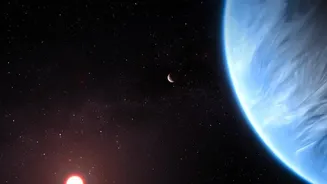
To see this process in action, look no further than K2-18 b, a super-Earth located 124 light-years away. First discovered by the Kepler Space Telescope, it became a prime target for JWST. Observations from Hubble had already hinted at water vapour in its atmosphere. When Webb turned its gaze upon the planet, it not only confirmed the presence of water but also detected methane and carbon dioxide. These observations were made by capturing the starlight filtering through K2-18 b's atmosphere during a transit. The data from NIRISS and NIRSpec provided a detailed breakdown of its atmospheric components, suggesting K2-18 b could be a 'Hycean' world—a hypothetical type of planet with a water ocean under a hydrogen-rich atmosphere. While not 'Earth 2.0,' the detailed chemical inventory of K2-18 b demonstrates JWST's incredible power to profile worlds that might have the right conditions for life.