







What is GISAT-1A?
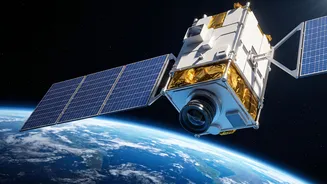
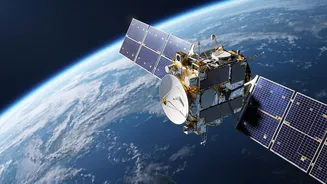
Think of GISAT-1A, also known as EOS-05, as India's unblinking eye in the sky. It is a state-of-the-art Earth observation satellite designed to operate from a geostationary orbit, about 36,000 kilometres above the Earth. Unlike satellites in lower orbits
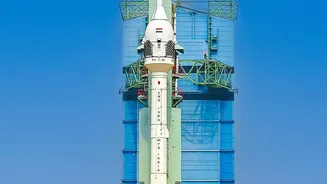
that pass over a location periodically, a geostationary satellite moves at the same speed as the Earth's rotation. This allows it to remain fixed over one spot on the equator, providing continuous surveillance of the Indian subcontinent. The satellite, weighing over 2,200 kg, will be launched aboard ISRO's powerful GSLV-F17 rocket. This mission is particularly significant as it is a second attempt after its predecessor, GISAT-1 (or EOS-03), was lost during a launch failure in August 2021 due to a technical snag in the rocket's cryogenic upper stage.
A Game-Changer in Real-Time Monitoring
The true power of GISAT-1A lies in its high temporal resolution—its ability to take pictures of the same area very frequently. The satellite is designed to image the entire Indian mainland every 30 minutes. For specific areas of interest, it can provide updates as quickly as every five minutes. This near real-time monitoring is a massive upgrade. For disaster management agencies, this means being able to track the rapid development of cyclones, monitor flooding as it happens, and get timely information on forest fires and landslides. This persistent watchfulness can save lives and property by enabling quicker, more informed responses to natural calamities.
Bolstering National Security
While its civilian applications are profound, GISAT-1A's strategic importance cannot be overstated. A constant eye over the subcontinent provides a significant advantage for national security. The ability to continuously monitor borders and areas of interest is a powerful tool for the armed forces, aiding in operational planning and enhancing situational awareness. In an era where geopolitical dynamics require constant vigilance, having an indigenous satellite that can provide persistent surveillance reduces reliance on foreign sources and strengthens India's strategic autonomy. It will join a growing constellation of satellites that form India's critical space-based infrastructure for defence and intelligence.
Beyond Security: A Boost for the Economy
The benefits of GISAT-1A extend deep into the civilian economy. The satellite's advanced multi-spectral and hyperspectral imaging capabilities will provide valuable data for a wide range of sectors. In agriculture, it will help in monitoring crop health, assessing yields, and managing water resources more effectively. For forestry, it can track deforestation and monitor the health of our green cover. The data will also be useful for urban planning, monitoring water bodies, mineral exploration, and studying glaciers and snow cover. By providing detailed and frequently updated information, GISAT-1A will become a key enabler for sustainable development and resource management across the country.
A Stepping Stone for India's Space Future
The September 4th launch is more than just a mission; it's a statement of resilience and ambition. A successful launch will not only heal the wound of the 2021 failure but also reaffirm the reliability of ISRO's GSLV rocket, especially its cryogenic upper stage. This success is crucial as India aims to expand its space activities, including the Gaganyaan human spaceflight mission and future interplanetary explorations. GISAT-1A, with its sophisticated technology and wide-ranging applications, perfectly embodies ISRO's focus on using space technology for national development. It solidifies India's position as a major space power capable of developing complex, strategically vital assets for the benefit of its people.