



More Than Just a Boat
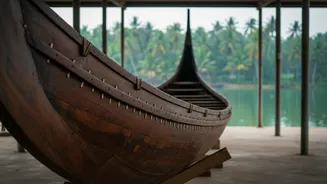
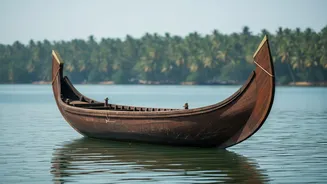
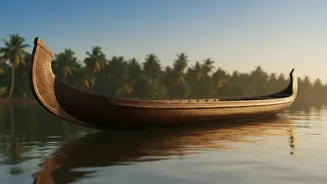
A Chundan Vallam is not merely a vessel; it is a village's pride and a revered icon of Kerala's culture. Stretching over 100 feet, with a distinctively curved rear rising 20 feet high, these boats resemble a snake with its hood raised. Each boat belongs
to a village, and its people treat it with a reverence usually reserved for a deity. Traditionally, only men are permitted to touch the boat, and they must do so barefoot as a sign of respect. This deep connection transforms the boat from a racing shell into a living embodiment of community spirit, its history rooted in 14th-century warfare between feudal kingdoms before evolving into a symbol of cultural celebration.
The Master's Sacred Calling
The creation of a snake boat rests in the hands of a master carpenter, known as the Moothashari or Asari. These craftsmen are more than just engineers; they are custodians of an ancient tradition passed down through generations. Their work combines mathematics, engineering, and spiritual practice without the aid of modern software. The boat's design follows principles laid out in the Sthapathya Veda, an ancient treatise on construction. The Moothashari intuitively understands hydrodynamics, shaping every curve of the hull with remarkable precision. A single mistake in measurement can affect the boat's speed and stability, making their role absolutely critical. The entire process begins on a day deemed auspicious, blending faith with function from the very first step.
From Forest to Water's Edge
The journey begins with the careful selection of wood. Craftsmen seek out the perfect Anjili tree, a type of wild jackfruit known for its resistance to rot and its flexibility in water. Once selected, the timber is transported to the 'Maalipura', a dedicated workspace near a body of water. Here, the Moothashari prepares a 'Rekhachithram', a reference drawing scaled down on a wooden plank, which serves as the only blueprint. Before the first cut is made, a ritual called 'Ulikuthal' marks the official commencement of construction, where the head carpenter makes a ceremonial first strike with a chisel, celebrated by the gathered villagers. This act signifies the start of a months-long process that will involve the entire community.
Rituals of Assembly and Awakening
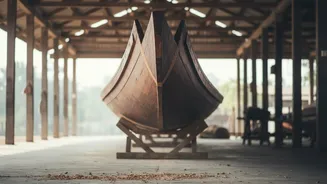
Building a Chundan Vallam is a sequence of sacred ceremonies. After the central keel, or 'eravupalaka', is laid, planks are carefully joined together using traditional techniques that allow the long hull to flex under pressure. A significant ritual is the 'Malarthal Karmam', where the entire village joins forces to invert the massive boat structure, a crucial step in its construction. As the boat takes shape, it is not merely assembled but brought to life. Before it touches the water for the first time, another ceremony is held. Villagers worship the boat, and its launch is a moment of immense pride and celebration. This is not just shipbuilding; it is a shared spiritual journey.
The Final Anointing
In the days leading up to a race, the snake boat undergoes its final preparations. A special concoction is prepared to coat the hull, a mixture of fish oil, carbon from burnt coconut shells, and eggs. This traditional varnish does more than make the boat shine; it waterproofs the wood and makes the surface slick, reducing friction and increasing speed in the water. The maintenance is an annual affair, a ritual that renews the boat's strength and readiness for competition. As the oarsmen, singing the rhythmic 'Vanchipattu' or boat songs, take their places, the boat ceases to be an object of wood and oil. It becomes a vessel of collective ambition, poised to slice through the water powered by synchronised strength and centuries of tradition.