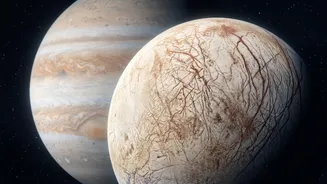



Beneath the cracked, icy shell of Jupiter's moon Europa lies one of the most compelling mysteries in our solar system: a vast, hidden ocean. NASA's Europa Clipper mission is on its way to find out if this alien sea has the ingredients for life.
An Ocean World Hiding in Plain Sight
For decades,
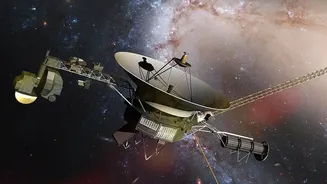
scientists have gathered tantalizing clues about Europa. Though smaller than Earth's moon, evidence suggests it hides a global ocean of salty liquid water beneath its frozen crust. This ocean may contain more than twice the amount of water found in all of Earth's oceans combined. The first hints came from the Voyager and Galileo missions, which revealed a surprisingly smooth surface with few craters, suggesting it is constantly being renewed from below. The key evidence came from Galileo's magnetometer, which detected a magnetic field around Europa that is best explained by a conductive fluid, like a salty ocean. This internal heat is thought to be generated by tidal flexing—the constant stretching and compressing of the moon by Jupiter's immense gravity, which keeps the ocean from freezing solid.
Enter the Europa Clipper
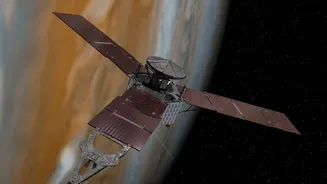
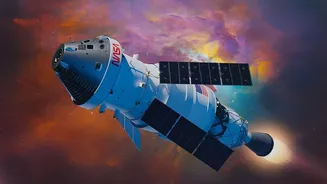
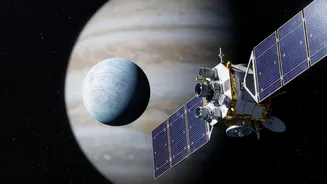
To investigate this promising world, NASA has dispatched the Europa Clipper, the largest interplanetary spacecraft the agency has ever built for a planetary mission. Launched in October 2024, the spacecraft is now on a multi-year journey covering 1.8 billion miles, including gravity-assist flybys of Mars in 2025 and Earth in 2026 to gain speed. It is scheduled to arrive in orbit around Jupiter in April 2030. Instead of orbiting Europa directly, which would expose it to Jupiter’s intense radiation, Clipper will make nearly 50 close flybys of the moon, some as low as 16 miles (25 kilometers) above the surface. This strategy allows the probe to gather detailed data from different regions while remaining operational for its planned multi-year science phase.
A Toolkit for an Alien Sea
The heart of the mission is a sophisticated suite of nine scientific instruments designed to work in concert to characterize Europa. The headline 'advanced sensors' primarily refers to instruments like the Radar for Europa Assessment and Sounding: Ocean to Near-surface (REASON) and the Europa Clipper Magnetometer (ECM). The REASON instrument is an ice-penetrating radar designed to peer through the moon's icy shell—which could be tens of miles thick—to confirm the ocean's existence, measure its depth, and search for pockets of water within the shell. The ECM, along with the Plasma Instrument for Magnetic Sounding (PIMS), will measure the strength, direction, and variability of Europa’s magnetic field. These measurements will help scientists determine the ocean’s salinity and depth, and the thickness of the ice above it.
More Than Just a Map
Other instruments will create a comprehensive picture of the moon. High-resolution cameras will map the fractured surface in unprecedented detail, while spectrometers will analyze the chemical composition of the ice, salts, and any organic materials present. One instrument, the Europa Thermal Emission Imaging System (E-THEMIS), will scan for hotspots, which could indicate areas where the ocean has interacted with the surface more recently. The mission will also search for and potentially analyze plumes of water vapor that scientists suspect may erupt from the surface, offering a direct sample of the ocean without having to drill through the ice. Together, this data will help scientists create a detailed map not just of the surface, but of the hidden environment below.
The Search for Habitability
Europa Clipper is not a life-detection mission; it will not be looking for alien microbes. Instead, its primary goal is to determine if Europa has the necessary ingredients for life as we know it: liquid water, essential chemical elements, and a source of energy. Scientists believe Europa checks all three boxes. The water is almost certainly present. The necessary chemicals for life, like carbon and sulfur, are thought to be on the surface and could be mixed into the ocean below. Energy could come from the tidal flexing that heats the moon's interior or from chemical reactions on the seafloor, similar to the hydrothermal vents that support vibrant ecosystems in Earth's deep oceans. By confirming these conditions, the mission will tell us if Europa is a potentially habitable world.