



The Sun’s Hidden Temper
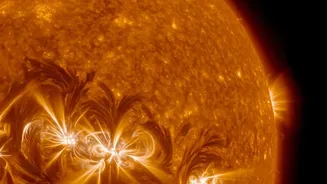
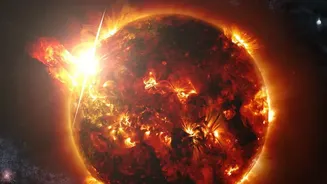
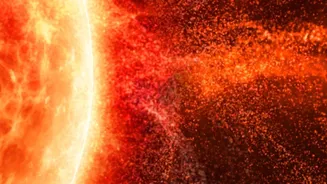
The Sun, the life-giving star at the centre of our solar system, has a temper. It frequently unleashes colossal explosions of energy and magnetised plasma known as Coronal Mass Ejections (CMEs). While many of these miss Earth entirely, a direct hit could
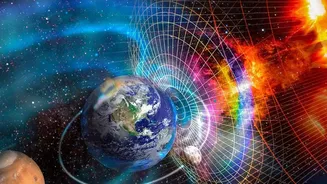
be catastrophic. A powerful CME can interact with Earth's magnetic field, triggering a severe geomagnetic storm. Such a storm could induce massive electrical currents in our power grids, potentially frying transformers and causing widespread, long-lasting blackouts. They can also disrupt satellite operations, scramble GPS signals, and black out high-frequency radio communications, affecting everything from air travel to national security. In our hyper-connected, technology-dependent society, the potential damage from a major event could be immense, impacting everything from digital payment systems to healthcare.
Seeing the Unseen: The Coronagraph
Predicting when these solar storms will hit is a monumental challenge. The key is to spot a CME as soon as it leaves the Sun. To do this, scientists use a special instrument called a coronagraph. A coronagraph works by creating an artificial eclipse; a small disc inside the telescope blocks the blindingly bright face of the Sun, allowing the much fainter outer atmosphere—the corona—to be seen. It is within this ethereal halo that CMEs are born. For decades, missions like the ESA/NASA Solar and Heliospheric Observatory (SOHO), launched in 1995, have used coronagraphs to give us a 1-to-3-day warning of Earth-directed storms. But as our reliance on technology has grown, so has the need for faster, more reliable warnings.
A New Generation of Solar Sentinels
This is where the breakthroughs come in. A new generation of coronagraphs is revolutionising space weather forecasting. These instruments are not just upgrades; they represent a fundamental leap in our capabilities. For example, NOAA's Compact Coronagraph (CCOR) instruments, flying on satellites like GOES-U, are designed as dedicated, operational forecasters. Unlike their aging predecessors, they deliver high-quality images of the corona every 15-30 minutes, and the data is available to forecasters in near real-time, a massive improvement on the potential eight-hour delays of older systems. At the same time, NASA's PUNCH mission uses a constellation of four small satellites working in unison to create 3D images of the solar wind as it flows from the Sun, tracking CMEs through the inner solar system for the first time.
The View from the Side and From Home
Another major advance is about observing position. Most solar observatories sit between the Earth and Sun at a location called Lagrange Point 1 (L1). India's own Aditya-L1 mission, a major national achievement, is stationed here, using its Visible Emission Line Coronagraph (VELC) to study the solar corona in unprecedented detail and provide crucial data on CMEs. But what if you could see the storm from the side? That's the plan for ESA's upcoming Vigil mission, set to launch around 2031. By positioning a spacecraft at Lagrange Point 5, trailing Earth in its orbit, Vigil will see the Sun's active regions days before they rotate into view from Earth. This unique vantage point will provide an earlier and clearer picture of CMEs hurtling toward us, potentially extending warning times to four or five days.
Turning Warnings into Action
This extra warning time is not just a scientific curiosity; it is a game-changer for protecting critical infrastructure. With hours or even days of advance notice, power grid operators can take preventative measures to protect vulnerable transformers. Satellite operators can put their spacecraft into a safe mode or reorient them to minimise damage. Airlines can reroute flights away from polar regions where communication blackouts are most severe. For a nation like India, which is rapidly expanding its digital infrastructure and space-based assets, this enhanced forecasting ability is vital. Missions like Aditya-L1 provide world-class, homegrown data, while international collaboration on new observatories like Vigil ensures we have the most complete picture possible of the threats heading our way, safeguarding our technological progress.