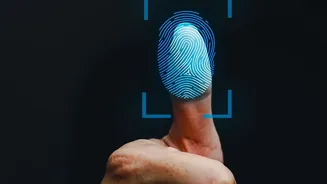




It sounds like a quirky fact for a trivia night, but it’s a baffling biological reality: the fingerprints of a koala are so strikingly similar to a human's that they can be difficult to tell apart, even under a microscope.
A Case of Mistaken Identity?
The resemblance between koala
and human fingerprints is not just superficial; the loops, whorls, and arches are fundamentally alike. This similarity is so profound that it has generated a popular, albeit unproven, narrative about koalas confusing crime scene investigations in Australia. While no formal cases of a koala's prints derailing a criminal investigation have been documented, forensic scientists have acknowledged the uncanny likeness. In 1996, anatomist Maciej Henneberg, who was among the first to formally study the phenomenon, noted that while it is extremely unlikely for koala prints to be found at a crime scene, police should be aware of the possibility. The fact that this topic is even discussed highlights just how identical the prints appear to the naked eye and even to microscopic analysis.
The Purpose of a Print
To understand why a koala would have fingerprints, it helps to understand why we have them. For a long time, the prevailing theory was that the ridges on our fingertips, known as dermatoglyphes, primarily increased friction to help with grip. While that may play a role, more recent thinking suggests their main purpose is to enhance our sense of touch. The ridges and valleys on our fingertips amplify vibrations and allow us to feel fine textures, helping our brains build a detailed picture of the objects we handle. This fine-tuned sensory input is crucial for primates, who rely on their hands to manipulate tools, find food, and navigate their environments. But koalas aren't primates.
A Koala's Grasp on Life
Koalas are marsupials, more closely related to kangaroos and wombats than to monkeys or apes. So, why the prints? The answer lies in their lifestyle. Koalas are arboreal, spending nearly their entire lives in eucalyptus trees. Their survival depends on their ability to climb and grip branches securely. Furthermore, they are notoriously picky eaters, often selecting eucalyptus leaves of a specific age and texture. Scientists believe koala fingerprints evolved to serve these two key functions: providing the grip needed to climb and the tactile sensitivity to select the right leaves for their diet. Their hands, complete with two opposable digits, are built for grasping and require precise sensory feedback, a need that fingerprints fulfill perfectly.
A Classic Case of Convergent Evolution
The fact that koalas developed fingerprints so similar to ours, despite being on a completely different branch of the evolutionary tree, is a textbook example of convergent evolution. This phenomenon occurs when two unrelated species independently evolve similar traits because they face similar environmental pressures or have similar needs. Humans and koalas parted ways from a common ancestor over 100 million years ago. Yet, both species evolved a need for fine-tuned gripping and sensing with their hands. Nature, in essence, arrived at the same solution—fingerprints—twice. It’s a powerful reminder that evolution isn't always about shared ancestry; sometimes it's about shared problems leading to shared solutions. The closest relatives of the koala, like wombats and kangaroos, do not have these prints, suggesting this is a relatively recent adaptation in the koala's lineage.