





A World of Hidden Water
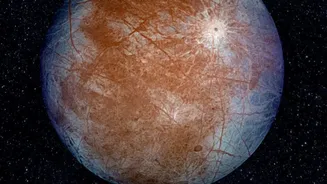
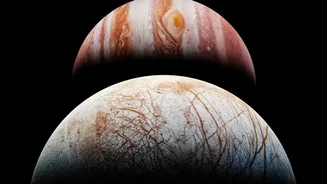
Europa has long fascinated scientists. Data from previous missions, like Galileo, revealed strong evidence of a global ocean hidden beneath an icy shell. This ocean is estimated to contain more than twice the amount of water found in all of Earth's oceans
combined. Its cracked and relatively young surface suggests a dynamic world where the ice shell moves and fractures, possibly allowing for interactions between the surface and the ocean below. This makes Europa a prime candidate in the search for habitable environments beyond Earth, as it may possess the three key ingredients for life as we know it: liquid water, essential chemical elements, and an energy source.
The Challenge: Peering Beneath the Ice
Confirming the ocean's existence and understanding its environment is the primary goal of the Europa Clipper mission. However, seeing through an ice shell that could be several kilometers to tens of kilometers thick is a monumental technological challenge. You can't just use a camera. To solve this, NASA has equipped the spacecraft with a powerful suite of instruments, chief among them a sophisticated ice-penetrating radar system designed to act like a planetary-scale ultrasound. This technology is crucial for mapping the ice shell in three dimensions and, most importantly, for finding the boundary where ice meets liquid water.
Meet REASON: The Ocean-Seeking Radar
The star of this subsurface investigation is an instrument called the Radar for Europa Assessment and Sounding: Ocean to Near-surface, or REASON. Developed with expertise honed from studying Earth's own Antarctic ice sheets, REASON is the only instrument on the spacecraft that can look directly into the ice. It works by transmitting radio waves at two different frequencies—9 MHz and 60 MHz—from large antennas extending from the spacecraft. These radio waves are designed to travel through ice but bounce back when they encounter changes in material, such as a layer of liquid water or different densities of ice.
A Dual-Frequency Approach
The two frequencies serve distinct but complementary purposes. The lower-frequency 9 MHz signal is designed for deep penetration, capable of sounding the ice shell down to a depth of about 30 kilometers to search for the main ocean interface. The higher-frequency 60 MHz signal provides higher-resolution detail of the upper few kilometers of the ice. This allows scientists to map the internal structure of the shell, identify any trapped pockets of water, and understand the complex geology hidden from view. By analyzing the time it takes for these radar echoes to return and their strength, scientists can create a detailed profile of what lies beneath the surface.
Searching for Signs of Habitability
The data from REASON is about more than just finding the ocean. It's about understanding Europa as a system. The radar will help characterize the thickness and structure of the ice shell, which is vital for understanding how it flexes and cracks under Jupiter's immense gravity. More excitingly, it could reveal pockets of water perched within the ice shell itself. These shallow lakes could be crucial zones where chemicals from the surface, altered by Jupiter's radiation, might mix with water from below. Identifying these pathways is a key step in determining whether the chemical ingredients necessary for life could reach the ocean, thereby assessing Europa's true potential for habitability.