







The explosive growth of artificial intelligence is pushing our digital infrastructure to its limits, leading to a truly futuristic idea: data centres in orbit. But as tech companies look to the stars for solutions, astronomers are raising alarms.
The New Frontier of Data
Imagine
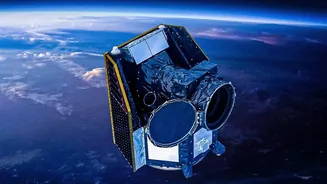
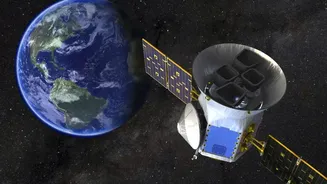
server farms not in sprawling terrestrial buildings, but housed within satellites, circling the Earth. This is the core idea behind orbital data centres (ODCs). Companies like SpaceX, Blue Origin, and others have filed proposals to launch vast constellations of these specialised satellites. The goal is to create a new layer of digital infrastructure in space to handle the intense processing demands of modern technology, especially artificial intelligence. These ODCs would be powered by near-continuous sunlight and cooled by the vacuum of space, addressing two of the biggest challenges for data centres on Earth: massive energy consumption and the need for water-intensive cooling systems. For some use cases, like processing data that must remain within a specific country's sovereign control, ODCs offer a unique solution. While still in early stages, the concept is moving from science fiction to a potential reality within the next decade.
AI's Insatiable Demand
The push for ODCs is driven by one primary factor: the staggering energy appetite of artificial intelligence. Training and running advanced AI models requires immense computational power, which translates to soaring electricity demand. By 2030, data centres could account for a significant portion of global electricity growth, with AI being the main driver. Terrestrial data centres are already straining local power grids in places like Northern Virginia and Ireland. Moving this workload into orbit offers a way to tap into the sun's abundant energy, with solar panels in space being far more efficient than on the ground. Proponents argue that this makes space the only scalable solution for the long-term growth of AI. However, the costs remain a major hurdle, with launch expenses keeping ODCs at a significant price premium compared to their earthly counterparts, though this gap is expected to narrow.
An Astronomer’s Nightmare
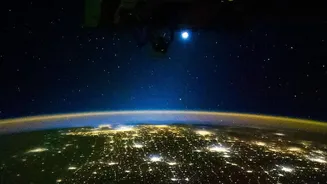
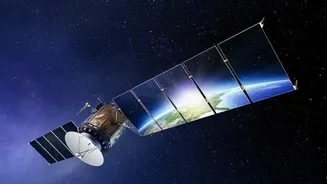
While tech visionaries see promise in the skies, astronomers see a looming crisis. The scientific community has been grappling with the impact of satellite 'megaconstellations' for years, and ODCs represent a potentially far greater threat. The International Astronomical Union (IAU) has warned that such constellations could pose a 'significant or debilitating threat' to astronomical infrastructure. The problems are twofold: light pollution and radio interference. Because ODCs are designed to be in near-constant sunlight to power their systems, they will be highly reflective. Proposals describe satellites that could be hundreds of times brighter than the brightest stars, creating bright streaks across scientific images and fundamentally altering the night sky for everyone. These satellites would be visible for long periods around twilight and, depending on their altitude, potentially all night long, severely impacting astronomical observations.
Blinding the Radio Telescopes
Beyond the visible light, ODCs create another, invisible form of pollution: radio noise. To be useful, these data centres must constantly communicate with Earth, transmitting vast amounts of data. These powerful downlink signals risk bleeding into the protected frequency bands that radio astronomers use to observe the universe. Radio telescopes are incredibly sensitive instruments designed to pick up faint cosmic signals. Interference from satellite constellations can easily overwhelm these signals, effectively blinding the telescopes and rendering years of research and investment useless. This issue is a primary concern for organisations like the Square Kilometre Array Observatory (SKAO) and has prompted international bodies to study new protections for radio astronomy.
Searching for Common Ground
The conflict between orbital computing and astronomy is not a simple case of good versus evil. Both fields represent frontiers of human achievement. The challenge is finding a way for them to coexist. Astronomical organisations like the IAU's Centre for the Protection of the Dark and Quiet Sky (CPS) are in active dialogue with industry players to develop mitigation strategies. Potential solutions include designing satellites with lesserestive surfaces, a strategy SpaceX has experimented with for its Starlink satellites, though with mixed results. For radio interference, proposals include steering satellite beams away from major radio observatories and better coordination of frequency use. However, the sheer scale of the proposed ODC constellations—some applications seek permission for up to a million satellites—may make any mitigation efforts insufficient. This has led to calls for stronger international regulation and a dedicated governing body to manage the increasingly crowded orbital environment before the sky is irrevocably changed.