


The Hunt for Habitable Worlds
For centuries, humanity has looked to the stars and wondered if we are alone. In modern astronomy, this grand question is often broken down into a more practical search for key ingredients for life. At the top of that list is liquid water. Here on Earth,
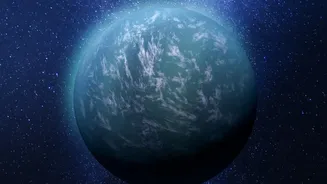
wherever we find water, we find life. This makes the hunt for water on planets outside our solar system, known as exoplanets, a top priority for astronomers. Finding water vapour in the atmosphere of a distant world would be a monumental step in identifying potentially habitable planets. Before the James Webb Space Telescope, this search was incredibly challenging, relying on limited data. Now, we've entered what NASA calls a "new era in exoplanet research," where detecting these faint signatures is finally possible.
How to See an Alien Atmosphere
Scientists can't just point a telescope and see a puddle on a planet hundreds of light-years away. Instead, they use a clever technique called transit spectroscopy. When an exoplanet passes, or 'transits', in front of its host star from our point of view, a tiny fraction of the starlight shines through the planet's atmosphere. Molecules in that atmosphere absorb very specific wavelengths, or colours, of light. By capturing the light from the star before, during, and after a transit, astronomers can see which colours are missing. These missing pieces create a unique chemical fingerprint, allowing scientists to determine what gases are present, such as methane, carbon dioxide, and most importantly, water vapour. This method essentially allows us to 'read' the atmospheric composition of a world we can never visit.
JWST's Infrared Advantage
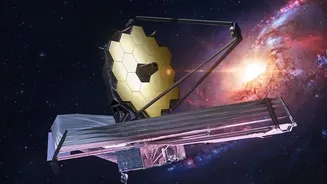
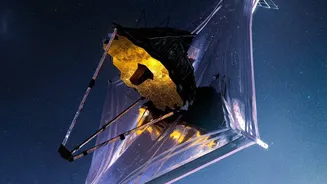
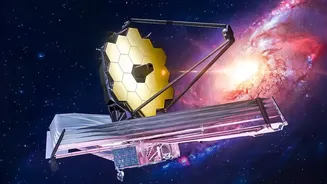
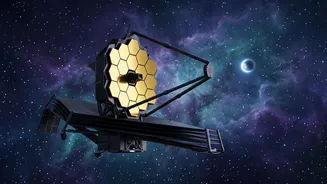
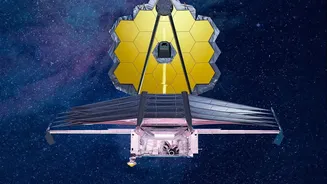
This is where the James Webb Space Telescope becomes essential. While the Hubble Space Telescope has analysed exoplanet atmospheres for years, even making the first clear detection of water in 2013, JWST represents a giant leap forward. The key is its specialisation in infrared light. Water vapour's most distinct and unmistakable absorption signals are in the infrared part of the spectrum, which is largely invisible to other telescopes. JWST's enormous mirror and highly sensitive infrared instruments, like the Near-Infrared Imager and Slitless Spectrograph (NIRISS), can capture these faint signals with unprecedented detail and clarity. It can see the tell-tale signs of water that were previously too subtle or entirely hidden, moving our capabilities from just 'detecting' to truly 'characterising' these alien atmospheres.
From Theory to Reality: Webb's Discoveries
The telescope has already proven its worth. In one of its first science releases, JWST provided a detailed spectrum from the gas giant WASP-96 b, located 1,150 light-years away. The data showed an "unambiguous signature of water" and also revealed the presence of clouds and hazes that were previously undetected. Since then, it has detected water vapour on other worlds, including the hot rocky planet GJ 486 b and the ultra-hot gas giant WASP-18 b. The sensitivity is so extraordinary that on WASP-18 b, it detected water despite temperatures hot enough to tear most water molecules apart. In another stunning feat, recent studies of the planet WASP-39 b have even used JWST data to detect 'semi-heavy water', a specific isotope that can provide clues about how a planet formed. These aren't just blurry hints; they are detailed measurements transforming our understanding.
More Than Just Finding Water
The ultimate goal is not just to find water but to understand the full context of a planet's environment. The same data that reveals water can also measure the amounts of other key molecules like carbon and oxygen. This allows scientists to build a more complete chemical inventory of an atmosphere, helping them distinguish between a sterile, wet rock and a world with active geological or biological processes. JWST can also probe the terrestrial regions of protoplanetary disks, where rocky planets are born, and has already detected water vapour in these planet-forming zones. This suggests that planets like Earth may have water available to them from the very beginning. By providing a complete picture, JWST's data is crucial for determining if a planet is truly habitable, not just whether it contains a single ingredient for life.