




A New Chapter in Cosmic Observation
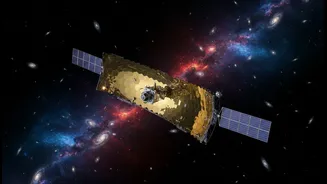
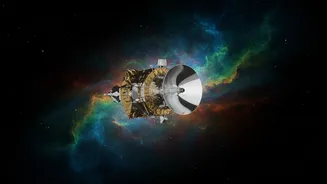
Scheduled for launch on August 30, 2026, the Nancy Grace Roman Space Telescope is NASA's next great observatory. While it has a primary mirror the same size as the Hubble Space Telescope, its power lies in its extraordinary field of view. The Roman Telescope's
Wide-Field Instrument (WFI) can capture an area of the sky 100 times larger than Hubble can in a single snapshot, with the same exquisite sharpness. Imagine trying to create a mural by taking thousands of tiny photos versus using a panoramic camera; Roman is the panoramic camera. This ability to conduct vast, deep surveys of the universe is what sets it apart. Instead of focusing on individual objects in great detail, Roman will create enormous cosmic maps, providing the statistical power needed to tackle some of the biggest questions in astronomy. It will see the big picture, collecting more data in its five-year primary mission than many previous missions combined.
Shining a Light on Dark Matter
Dark matter is one of science's most profound mysteries. It makes up about 27% of the universe, but it doesn't emit or reflect light, making it invisible. We only know it's there because of its gravitational effects on the things we can see. Roman will hunt for it using a technique called gravitational lensing. As predicted by Einstein, massive objects warp the fabric of space-time, bending the light from more distant objects behind them. By observing how the light from billions of galaxies is subtly distorted, Roman can map the distribution of all matter, including the invisible dark matter. Its wide view is crucial here; by surveying millions of galaxies, it can perform a statistical analysis of this “weak lensing” effect on a massive scale, revealing how dark matter is clumped together and distributed throughout the cosmos. Scientists estimate Roman could identify over 160,000 gravitational lenses, giving them an unprecedented dataset to test theories about the fundamental nature of this mysterious substance.
A Grand Census of New Worlds
While the Kepler and TESS missions have discovered thousands of exoplanets, they are biased toward finding large planets orbiting very close to their stars. Roman will complete the planetary census using two methods, with a focus on a powerful technique called gravitational microlensing. This occurs when a star or planet passes almost perfectly in front of a more distant star, and its gravity acts as a lens, briefly magnifying the background star's light. A planet orbiting the foreground star creates its own tiny signature on this light curve. Because Roman will stare at the dense, star-packed center of our galaxy for long periods, it's expected to catch thousands of these fleeting events. This method is sensitive to planets of all sizes, including Earth-mass worlds, and at wider orbits similar to those in our own solar system. It can even find “rogue” planets that drift through space without a host star. Projections suggest Roman could discover thousands of planets via microlensing and up to 100,000 more using the traditional transit method, transforming our understanding of planetary demographics across the galaxy.
Mapping the Expanding Universe
In the late 1990s, astronomers discovered that the expansion of the universe is accelerating, driven by a repulsive force dubbed “dark energy.” This force makes up a staggering 68% of the cosmos, yet we know almost nothing about it. The Roman Telescope will tackle this mystery by conducting massive galaxy surveys. By mapping the precise locations of hundreds of millions of galaxies across cosmic time, it will trace the history of the universe's expansion. It will use several methods, including measuring the distribution of galaxies to look for the imprint of primordial sound waves (Baryon Acoustic Oscillations) and observing thousands of distant Type Ia supernovae, which act as “standard candles” to measure cosmic distances. This multi-pronged approach will allow scientists to chart the influence of dark energy over billions of years, determining if it has been constant or has changed over time—a key clue to its true nature and the ultimate fate of our universe.