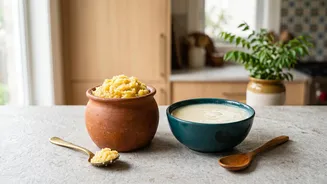








Ghee is the undisputed heart of the Indian kitchen. But when faced with two jars, one of cow ghee and one of buffalo ghee, the choice isn't always clear. Beyond the obvious source, what truly sets them apart? Let’s break it down.
Colour, Taste, and Texture
The most immediate difference
is visual. Cow ghee has a characteristic golden-yellow hue, while buffalo ghee is creamy white. This colour variation isn't about purity; it's about biochemistry. Cows pass the beta-carotene from their plant-based diet directly into their milk fat, giving the ghee its yellow colour. Buffaloes, on the other hand, convert this beta-carotene into the colourless vitamin A, resulting in white ghee. In terms of flavour, cow ghee is often described as having a lighter, nutty, and more aromatic taste, making it a versatile choice that doesn't overpower dishes. Buffalo ghee has a richer, stronger flavour and a denser, creamier texture, which many prefer for making sweets or robust curries. Buffalo ghee also tends to set firmer due to its different fatty acid structure.
A Nutritional Deep Dive
Nutritionally, both types of ghee are primarily fat, but the composition differs in important ways. Buffalo ghee has a higher fat content and is more calorie-dense than cow ghee. This makes it a great source of instant energy, often preferred by athletes or those engaged in heavy physical work. Conversely, cow ghee is lighter and contains slightly fewer calories, making it a more suitable option for those managing their weight. Cow ghee is also noted for having a higher concentration of fat-soluble vitamins like A, D, E, and K, along with more polyunsaturated fatty acids. While buffalo ghee also contains these nutrients, it is particularly rich in minerals like calcium, magnesium, and phosphorus.
Performance in the Kitchen
In the kitchen, the choice often comes down to the specific cooking task. Buffalo ghee has a slightly higher smoke point (around 250°C) compared to cow ghee (around 230°C), making it marginally better for high-heat cooking like deep-frying. However, both have high smoke points suitable for most Indian cooking methods, including tadka and sautéing. Due to its rich and heavy texture, buffalo ghee is a favourite for making traditional sweets (mithai) and hearty dishes where a creamy consistency is desired. Cow ghee's lighter texture and milder flavour make it ideal for daily use, such as spreading on rotis, drizzling over dal and rice, or for general light cooking where you want the other ingredients to shine.
Health and Ayurvedic Wisdom
From a health perspective, cow ghee is generally considered easier to digest. Its fat composition, including more medium-chain fatty acids, makes it gentler on the stomach, which is why it's often recommended for children and the elderly. In Ayurveda, cow ghee is revered as a 'satvik' food, believed to promote positivity and clarity. It's traditionally used to balance all three doshas. Buffalo ghee, being heavier, is said to be better for those looking to gain weight and is traditionally used in winter for its warming properties. For those concerned about cholesterol, some sources suggest that cow ghee is a better option due to its lower saturated fat content compared to buffalo ghee, which should be consumed more sparingly by those with heart health concerns.
Shelf Life and Cost
Buffalo milk contains nearly double the fat of cow's milk. Because it takes less milk to produce a kilogram of buffalo ghee, it is often more affordable than cow ghee. The higher fat content in buffalo ghee also contributes to a slightly longer shelf life, as there is less moisture content. Cow ghee, particularly A2 ghee from indigenous breeds, can be more expensive to produce due to the lower fat yield from the milk.