



The Year-Day Paradox
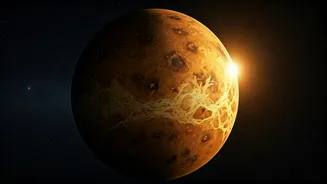
Let's get the core fact straight, because it’s a genuine brain-twister. A year on Venus—the time it takes to complete one full orbit around the Sun—is about 225 Earth days. In contrast, a single day on Venus—the time it takes for the planet to complete one full rotation
on its axis—is approximately 243 Earth days. That’s right: a Venusian day is longer than a Venusian year. You would complete an entire trip around the Sun before the planet itself has even finished spinning once. This isn't a riddle or a trick; it's the fundamental, strange reality of our nearest planetary neighbour. On Earth, we are so accustomed to the simple rhythm of 365 days in a year that the Venusian calendar feels like it’s from an alternate dimension.
Spinning the Wrong Way
Part of the reason for this temporal confusion is Venus’s exceptionally slow and retrograde rotation. While Earth and most other planets in our solar system spin counter-clockwise on their axes, Venus spins clockwise. If you could stand on its surface, you would see the Sun rise in the west and set in the east. This backward spin is incredibly leisurely. A full 360-degree rotation takes 243 Earth days, making it the slowest spinning planet in our solar system by a huge margin. Scientists are still debating why Venus spins this way. The leading theories suggest a colossal impact early in its history may have knocked it off-kilter, or that the gravitational pull from the Sun on its incredibly thick, heavy atmosphere created a tidal drag that gradually slowed its rotation and eventually reversed it.
Two Kinds of 'Day'
Here’s where it gets even more interesting. While one full rotation (a "sidereal day") takes 243 Earth days, the time from one sunrise to the next (a "solar day") is a different story. Because the planet is slowly spinning backward while it’s also orbiting the Sun, the two motions interact in a strange way. The result is that a solar day on Venus is much shorter than its rotational period. The time from noon to noon on Venus is about 117 Earth days. So, while the planet itself takes 243 days to turn around, you’d only have to wait 117 days for the Sun to return to the same spot in the sky. This means there are roughly two sunrises and two sunsets within a single Venusian year. It's a cosmic dance where the steps are all out of sync with what we consider normal.
A Day on the Surface
Let’s ignore for a moment that the surface of Venus is a crushing, hellish landscape with temperatures hot enough to melt lead and an atmosphere of carbon dioxide and sulfuric acid clouds. If you could survive, your sense of time would be completely warped. The Sun would appear as a dim glow through the thick clouds, slowly crawling from west to east across the sky. This 'daylight' period would last for nearly two Earth months. Then, you would plunge into a night that also lasts for another two Earth months. Throughout this long, slow day and night cycle, the planet itself would not have even completed a full rotation, yet you could have passed your Venusian 'birthday'. It’s a place where our fundamental concepts of day and year simply don't apply.
A Reminder of Cosmic Weirdness
The strange case of Venus’s long day and short year is a powerful reminder of how beautifully diverse and non-intuitive the universe can be. We often project our Earthly experiences onto the cosmos, but planets like Venus show us that nature follows the laws of physics, not our expectations. It's a world governed by a completely different clock, a celestial oddity that continues to challenge our understanding of how planets form, evolve, and dance with their stars. It also highlights why continued space exploration is so vital. Each new piece of data from probes studying Venus helps us piece together the puzzle of its past and understand the vast range of possibilities for planets elsewhere in the galaxy.