





2001: A Space Odyssey (1968)
Long before digital effects became the norm, Stanley Kubrick’s masterpiece set an impossibly high bar using purely practical methods. The film is a slow, deliberate ballet of spacecraft set to classical music, and its power lies in its commitment to realism.
Kubrick’s team built massive, rotating sets to simulate artificial gravity, a technique that cost a significant portion of the budget. The iconic floating pen was achieved not with wires, but by sticking it to a large, rotating sheet of glass. Even the trippy “Star Gate” sequence, a psychedelic journey through light and colour, was created with an innovative analogue technique called slit-scan photography, which involved moving a camera past a backlit slit. It’s a testament to the crew’s ingenuity that a film from 1968 remains a benchmark for visual storytelling in science fiction.
Gravity (2013)
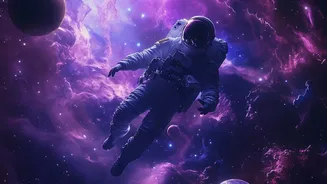
If ‘2001’ was a stately dance, Alfonso Cuarón’s ‘Gravity’ is a heart-pounding panic attack in zero gravity. The film’s brilliance is in making the audience feel the sheer terror and isolation of being stranded in orbit. The visual effects team at Framestore essentially created a digital film, where the only physically real elements in most shots were the actors' faces. To achieve the seamless, long takes of characters tumbling through space, the actors were placed inside a “lightbox,” an enclosure of LED panels that projected the starfields and Earth onto their visors, creating realistic lighting and reflections. Cameras were mounted on huge robotic arms to execute the complex, weightless choreography. The result is a visceral, immersive experience that puts you right inside the helmet, making every piece of flying debris a personal threat.
Interstellar (2014)
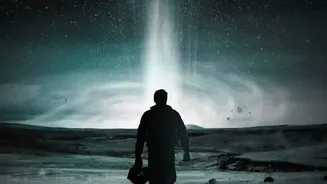
Christopher Nolan is known for his dedication to practical effects and in-camera realism, and ‘Interstellar’ took that philosophy to an epic, cosmic scale. To ensure scientific accuracy, Nolan collaborated with theoretical physicist Kip Thorne. This partnership led to what many consider the most realistic depiction of a wormhole and a black hole in cinema history. The visual effects team developed new rendering software based on Thorne's equations to simulate how light would actually bend around these massive gravitational objects. This process was so groundbreaking that it resulted in a new scientific discovery about the appearance of black hole accretion disks. The journey through the wormhole isn't just a flashy tunnel of light; it's a spherical distortion of space, a window into another galaxy that feels both alien and profoundly real.
The Martian (2015)
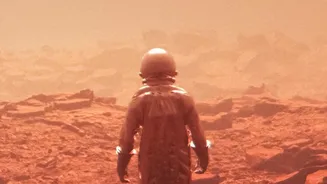
While other films on this list explore the fantastical, Ridley Scott’s ‘The Martian’ grounds its spectacle in near-future reality. The film’s visual appeal comes from its meticulous and believable depiction of Mars and NASA technology. Rather than focusing on cosmic wonders, the VFX team concentrated on making the desolate beauty of the red planet feel tangible. The sweeping vistas of the Martian landscape, the detailed interiors of the habitat, and the functional design of the spacecraft all contribute to a sense of authenticity. This isn’t a story about battling aliens but about surviving an indifferent environment. The visual effects serve that story perfectly, creating a world that is simultaneously beautiful and deadly. The spectacle here isn’t magic; it’s the awe-inspiring power of human ingenuity against the vast, silent backdrop of space.
Dune (2021)
Denis Villeneuve’s adaptation of the classic sci-fi novel is a masterclass in scale and world-building. While much of the story takes place on the desert planet of Arrakis, the film is a true space opera, and its visual language emphasizes immense size and ancient history. The design of the spaceships—from the dragonfly-like ornithopters to the monolithic Heighliners—blends futuristic technology with an almost brutalist, industrial aesthetic. To maintain a grounded feel and help the actors, the visual effects team innovatively used sand-colored screens on set instead of traditional green or blue screens, allowing for more natural light interaction. The sheer scale of the desert, the terrifying emergence of the giant sandworms, and the grandeur of the star-spanning empire are all rendered with an artistic, painterly quality that makes every frame feel like a piece of concept art brought to life.