



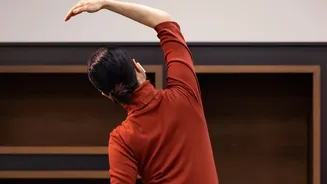

Why Your Hips Protest After Sitting
Our bodies are designed for movement. When you sit for long periods, your hips are held in a flexed position. This causes the muscles at the front of your hips, the hip flexors, to shorten and tighten. Meanwhile, the muscles on the opposite side, your glutes,
become inactive and weak from disuse. This muscular imbalance pulls on your pelvis, reduces circulation, and can lead to stiffness, poor posture, and even lower back pain. The goal of mobility work is to counteract these effects by 'waking up' dormant muscles and lengthening shortened ones.
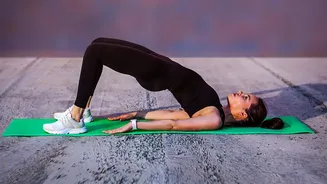
1. The Glute Bridge
This is a fundamental exercise for counteracting the effects of sitting. It reactivates the gluteal muscles, which are essential for hip stability and power. Strengthening them helps take the strain off your lower back and rebalances the pelvis. How to do it: Lie on your back with your knees bent, feet flat on the floor about hip-width apart, and your arms by your sides. Press through your heels and squeeze your glutes to lift your hips toward the ceiling until your body forms a straight line from your shoulders to your knees. Avoid arching your back; the movement should come from your hips. Hold for a few seconds at the top before slowly lowering back down. Aim for 10-15 repetitions.
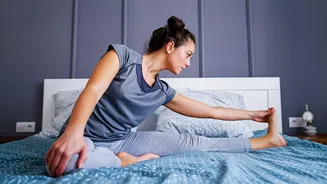
2. Seated Butterfly Stretch
A simple stretch that targets the inner thighs and opens the hips, the butterfly stretch can easily be done at a desk or on the floor. It helps to gently increase flexibility in the hip joints. How to do it: Sit on the floor or on the edge of a chair with your back straight. Bring the soles of your feet together and let your knees drop out to the sides. Gently hold your feet or ankles. If you want a deeper stretch, you can lean forward slightly or gently press your knees down with your elbows. Hold the stretch for 20-30 seconds, breathing deeply. Do not bounce.
3. Kneeling Hip Flexor Stretch
This stretch directly targets the hip flexors that become short and tight from prolonged sitting. Lengthening these muscles is crucial for restoring a full range of motion and relieving the 'pulling' sensation at the front of your hips. How to do it: Kneel on one knee, placing your other foot flat on the floor in front of you to create a 90-degree angle. Keeping your back straight and your core engaged, gently push your hips forward. You should feel a stretch in the front of the hip of the kneeling leg. For a deeper stretch, you can raise the arm on the same side as your back leg straight up. Hold for 30 seconds and then switch sides.
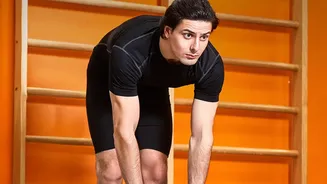
4. Standing Hip CARs
CARs, or Controlled Articular Rotations, are active movements designed to take a joint through its full range of motion. This helps lubricate the hip joint, improve mobility, and maintain joint health. The key is to move slowly and with control. How to do it: Stand next to a wall or chair for balance. Keeping your torso upright and core braced, slowly lift one knee up toward your chest. From there, open your knee out to the side (like opening a gate), then rotate your heel up towards the ceiling as you guide your leg back behind you before returning to the start. The goal is to make the biggest, smoothest circle possible with your knee without moving your torso. Perform 3-5 slow rotations in each direction, then switch legs.