

Meet S/2023 U1
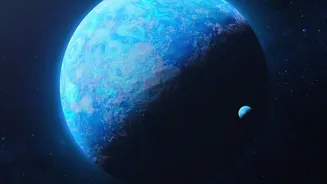
The newcomer, provisionally named S/2023 U1, is tiny. With an estimated diameter of only about 8 kilometres, it is likely the smallest of Uranus’s 28 known moons. It was first spotted in November 2023 by astronomer Scott Sheppard using the powerful Magellan
telescopes in Chile. Confirming its existence was a feat of celestial detective work, requiring follow-up observations and even finding the faint object in archival images from 2021. This moon is so faint and distant that it took special image processing techniques, stacking multiple long-exposure images, to make it visible against the glare of Uranus and the trail of background stars.
A Long and Distant Journey
What makes S/2023 U1 particularly interesting is its orbit. It takes the small moon a lengthy 680 Earth days to complete a single trip around Uranus. Its path is distant, eccentric, and highly inclined, characteristics that define it as an “irregular moon.” These types of moons are believed to be captured objects — wanderers from the early solar system that strayed too close to the giant planet and were snared by its gravity, rather than forming in place. This capture theory is supported by the fact that its orbit is similar to two other Uranian moons, Caliban and Stephano, suggesting they may all be fragments of a larger parent body that was captured and then shattered by a collision long ago.
The Significance of a Tiny Moon's Path
A moon's orbit can reveal a great deal about its planetary system. While S/2023 U1 is too distant to be a 'shepherd moon' for Uranus's main rings, its discovery helps complete the census of the planet's outer moon system. Understanding the orbits of these captured moons helps scientists refine their models of the chaotic early days of the solar system. The paths of these small bodies hold clues about how the giant planets migrated and settled into their current positions, a process that profoundly affected the entire solar system. By studying these orbital families, astronomers can piece together a history of ancient collisions and gravitational interactions.
Completing the Family Portrait
The discovery of S/2023 U1 reinforces that Uranus has a population of outer moons similar to those found around Jupiter and Saturn. For years, Uranus was the last giant planet without any known irregular moons, but continued searches have revealed a complex and diverse family. This suggests that the process of capturing and breaking up moons is a common feature of giant planet formation across our solar system. Each new discovery, no matter how small, provides another crucial data point. It helps us understand whether a planet's history was relatively calm or, as in Neptune's case, violently disrupted by the capture of a large object like its moon Triton.