








A Strategic Shift in Ambition
For decades, the Indian Space Research Organisation (ISRO) focused on using space for national development—bringing communications, weather forecasting, and remote sensing to the masses. That foundational, state-led approach is now evolving. A series
of reforms, including the Indian Space Policy of 2023, have opened the floodgates for private companies and refocused ISRO on research and development of next-generation technologies. The goal is to grow India's space economy from around $8-9 billion today to over $44 billion by the next decade. This isn't just about economic growth; it's a strategic push for greater capabilities in a world where space is increasingly tied to national security and geopolitical influence.
The Dawn of 'Smart' Satellites
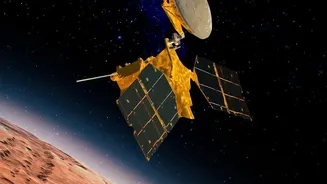
The term “smart satellites” marks a move away from passive relays to active, intelligent assets in orbit. For India, this means developing satellites with onboard artificial intelligence and reconfigurable systems. Instead of just collecting data and sending it back to Earth for processing, these future satellites will be able to analyze information in real-time. For example, a smart surveillance satellite could autonomously detect a threat, prioritize the data, and send an alert without human intervention. This capability is critical for military intelligence and disaster management. One recent private-sector success, the Drishti satellite, is the world's first to combine optical and synthetic aperture radar (SAR), allowing it to see through clouds and at night—a key feature of next-generation observation.
The Unhackable Promise of Quantum Links
Perhaps the most futuristic part of India's strategy is its investment in quantum communication. Unlike conventional encryption, which relies on mathematical complexity, quantum communication uses the laws of physics to create secure channels. Any attempt to intercept the data disturbs the quantum state, immediately revealing the breach. This makes it theoretically unhackable—a game-changer for military, financial, and governmental communications. ISRO has already successfully demonstrated free-space Quantum Key Distribution (QKD) over a 300-meter distance, including securing a live video conference. The ultimate goal is to establish Satellite-Based Quantum Communication (SBQC), creating a secure network between satellites and ground stations, a capability only a handful of nations are pursuing.
Fostering a 'NewSpace' Ecosystem
This ambitious strategy is not just about ISRO. A crucial component is the empowerment of a domestic private space industry, often called 'NewSpace'. Since reforms began in 2020, the number of space startups in India has grown from a handful to over 400. The government established the Indian National Space Promotion and Authorisation Centre (IN-SPACe) as a single-window agency to authorize and facilitate private space activities, from building rockets to operating satellite constellations. This has spurred innovation, with companies like Skyroot Aerospace developing their own orbital rockets and GalaxEye building advanced multi-sensor satellites. This public-private partnership model allows ISRO to focus on pioneering research while the private sector drives commercialization and manufacturing.
Why It Matters for the U.S.
India's emergence as a high-tech space power is significant for the United States. It presents both a new competitor in the booming commercial space market and a vital strategic partner. As China rapidly expands its own space capabilities, a technologically advanced India offers a key democratic counterweight in Asia. The U.S. and India are already collaborating on space missions, and this deepening expertise makes India an even more valuable partner for future projects like lunar exploration. For American businesses, India's growing space economy opens up new opportunities for investment and collaboration, particularly as India's private sector matures and integrates into the global supply chain. Watching India's space strategy unfold is no longer about observing a regional player; it's about witnessing the rise of a new global force in the final frontier.