



Meet the 'Steam World'
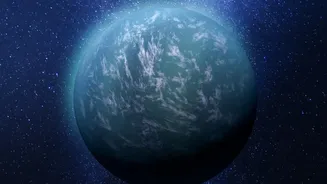
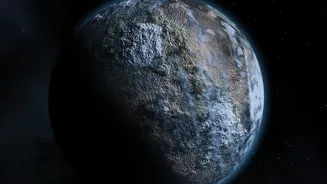
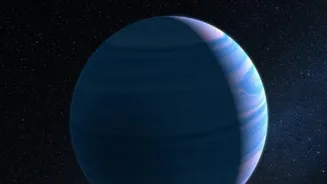
The planet at the centre of this groundbreaking discovery is GJ 9827 d, located about 97 light-years from Earth in the constellation Pisces. It’s not a terrestrial, rocky world like Earth, nor a massive gas giant like Jupiter. Instead, it falls into a mysterious
category of planets with no analogue in our solar system, often called sub-Neptunes. Roughly twice the diameter of Earth, scientists have now confirmed that GJ 9827 d has an atmosphere rich in water. This has led some to nickname it a 'steam world'—a planet theoretically possible for years, but now observationally confirmed for the first time. However, this world is far from a tropical paradise; with surface temperatures soaring to around 425 degrees Celsius, it’s an inhospitable, steamy environment.
How Webb Saw the Unseen
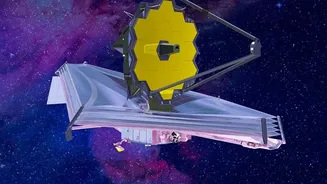
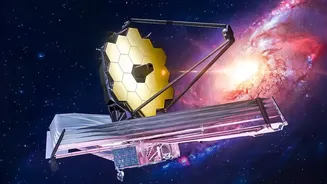
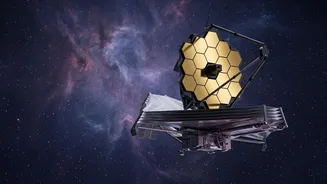
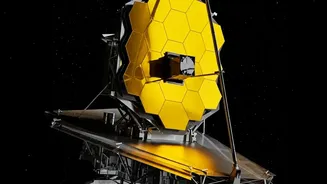
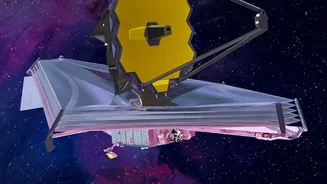
Detecting the chemical makeup of an atmosphere nearly 100 light-years away is a monumental technical challenge. Scientists achieved this using a technique called transmission spectroscopy. As GJ 9827 d passed in front of its host star, the JWST's powerful Near-Infrared Imager and Slitless Spectrograph (NIRISS) instrument analysed the starlight filtering through the planet's atmosphere. Different molecules absorb light at specific wavelengths, leaving a unique chemical fingerprint. While the Hubble Space Telescope had previously found hints of water, JWST's superior sensitivity confirmed that the atmosphere isn't just laced with water, but is in fact water-rich. This discovery is especially significant because most exoplanet atmospheres studied to date have been dominated by light gases like hydrogen and helium. GJ 9827 d is one of the first small planets shown to have an atmosphere rich in heavier molecules, similar to the terrestrial planets in our own solar system.
From Atmosphere, Not Surfaces
It’s important to clarify that this discovery is of abundant water vapour in the planet's atmosphere, not evidence of liquid water on its surface. Given the planet’s scorching temperature, which is comparable to that of Venus, any water on the surface would exist as steam. Scientists are currently exploring two main possibilities for this water-rich world. One scenario suggests GJ 9827 d is a 'mini-Neptune' that is still holding on to a hydrogen-rich atmosphere that is laced with a large amount of water. The alternative, and more exciting, possibility is that it is a warmer version of a world like Jupiter's moon Europa. In this case, the planet may have formed further from its star where water ice is plentiful, and then migrated inward. The star's intense radiation would have boiled off the ice and stripped away lighter atmospheric gases, leaving behind a dense, steamy envelope of water vapour.
A Stepping Stone in the Search for Life
While GJ 9827 d itself is not considered habitable for life as we know it, this finding is a crucial stepping stone. For years, detecting atmospheres on smaller, rocky planets has been an elusive goal for astronomers. Most successes were with giant planets. Proving that a small planet can host and retain a water-rich atmosphere is a landmark discovery. It shows that the tools and techniques are now available to begin characterizing worlds that are closer in size to our own. This is a necessary step toward the ultimate goal of finding truly Earth-like environments. Scientists can now use the JWST to study other, more temperate planets with the knowledge that detecting the chemical signs of potential habitability is within reach.