



The Ultimate Cosmic Delay
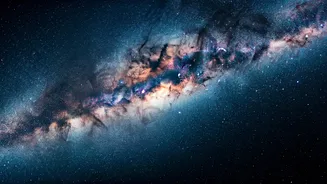
We think of light as instantaneous. You flip a switch, and the room is bright. But in the vastness of space, this isn't true. Light, though incredibly fast, has a finite speed: about 300,000 kilometres per second. Over the immense distances between stars
and galaxies, this creates a noticeable delay. Think of it like watching a distant firework display. You see the explosion of light first, and then, seconds later, you hear the boom. Sound is much slower than light. In space, the distances are so enormous that even light itself experiences a significant travel lag. Astronomers measure these distances in light-years. One light-year is the distance light travels in a single year—a staggering 9.5 trillion kilometres. So, when we say a star is 100 light-years away, we mean the light we are seeing tonight left that star 100 years ago. You aren't seeing the star as it is today; you're seeing it as it was when your great-grandparents were young. Every telescope is, in essence, a time machine.
Portrait of a Star's Ghost
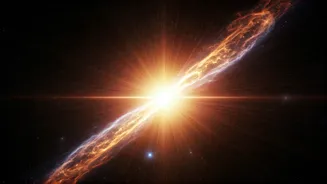
One of the most spectacular examples of this phenomenon is the Crab Nebula. Visible through a decent telescope, it looks like a beautiful, tangled cloud of glowing gas—a true 'sky glare'. But this beautiful sight is the ghost of a violent death. The light from the explosion that created this nebula first reached Earth in the year 1054 AD. Astronomers in China and the Arab world recorded the appearance of a dazzling 'guest star' in the sky, so bright it was visible during the day for 23 days. What they witnessed was a supernova—the cataclysmic explosion of a massive star. The Crab Nebula is the expanding wreckage from that explosion. Here’s the mind-bending part: the nebula is about 6,500 light-years away. This means the supernova didn't happen in 1054; it happened roughly 6,500 years *before* that. The light simply took that long to travel across the galaxy and reach the eyes of our ancestors. The event itself is ancient history, but its light is still arriving, painting a picture of the past across our night sky.
What We See Inside the Glare
When modern astronomers point powerful instruments like the Hubble Space Telescope at the Crab Nebula, they are not just seeing a static cloud. They are watching a 6,500-year-old event unfold in slow motion. The intricate web of filaments we see is gas from the exploded star, still expanding outwards at over 1,500 kilometres per second. The colours tell a story: different hues correspond to different elements created in the star’s core and flung out into space—oxygen, sulphur, iron, the very building blocks of planets and people. At the heart of this beautiful chaos lies something even more extreme: a pulsar. This is the super-dense, collapsed core of the original star, no bigger than a city but more massive than our sun. It spins on its axis 30 times a second, sweeping beams of radiation across space like a cosmic lighthouse. This engine is what energises the entire nebula, making it glow so brightly. We are, in effect, watching the crime scene of a star's death, with the 'weapon' still spinning at its centre.
Why This Ancient Light Matters
Studying these ancient light signals is more than just cosmic sightseeing. These nebulae are cosmic laboratories. By analysing the light, scientists can understand the lifecycle of stars, a process fundamental to our own existence. Supernovae are the universe's primary factories for heavy elements. The calcium in our bones and the iron in our blood were forged inside a star that exploded billions of years ago. By studying the Crab Nebula, we learn about the origins of the materials that make up our world and ourselves. Furthermore, these celestial events help us test the laws of physics under conditions of extreme gravity, temperature, and density that are impossible to replicate on Earth. They are natural experiments on a grand scale, and the data has been travelling towards us for millennia, a gift from the deep past.