
Reading Light from a Distance
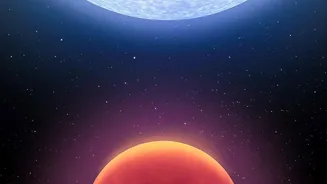
To find out what an exoplanet’s atmosphere is made of, astronomers use a technique called transit spectroscopy. It works when a planet passes, or transits, in front of its host star from our point of view. As the starlight shines through the edge of the planet's
atmosphere, gases and chemicals within it absorb very specific colours, or wavelengths, of light. Back on Earth, scientists can analyse the light that reaches their telescopes, see which colours are missing, and create a chemical fingerprint of that distant atmosphere. This reveals which molecules, like water vapour, methane, or carbon dioxide, are present.
The Technology Behind the Hunt
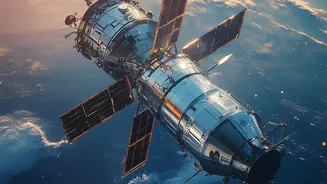
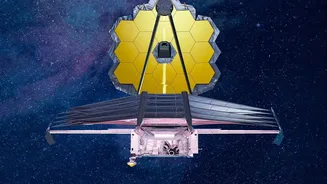
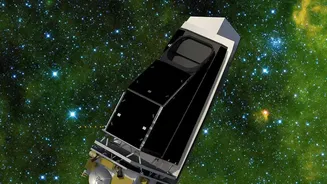
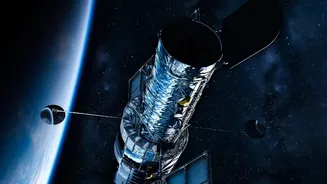
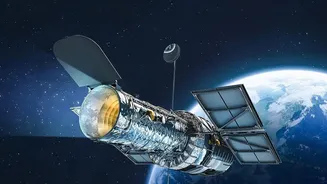
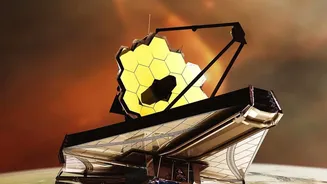
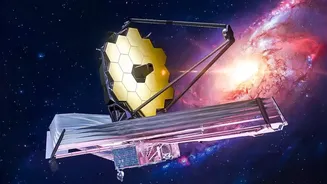
This incredibly precise work requires space-based telescopes, because Earth's own atmosphere interferes with the light, hiding the very signals astronomers need to see. The Hubble Space Telescope pioneered this work, providing the first glimpses into alien atmospheres and detecting water and other compounds. Now, the James Webb Space Telescope (JWST) has taken this science to a new level. With its powerful instruments, called spectrographs, JWST can capture far more detailed atmospheric profiles, identifying a wider range of molecules with greater confidence.
The Chemical Signs of Life
The gases that astronomers are most interested in are called biosignatures—substances that are produced by living organisms. On Earth, life constantly produces gases like oxygen, methane, and carbon dioxide. While some of these can also be created by geological or chemical processes, finding them in certain combinations can be a strong indicator of biological activity. For example, oxygen and methane naturally destroy each other. Finding both in the same atmosphere suggests something is constantly replenishing them, and that 'something' could be life. This state of chemical imbalance, or disequilibrium, is a key sign that a planet might be living.
The Challenge of False Positives
The hunt for biosignatures is not straightforward. Scientists must be careful to rule out non-biological explanations, known as false positives. Oxygen, for instance, is a major biosignature on modern Earth, but it can also be produced when intense starlight breaks down water molecules in a planet's atmosphere. Similarly, methane can be released by volcanoes. This means context is critical. Astronomers need to understand the planet's size, its star's activity, and the presence of other gases to build a convincing case for life. For example, finding methane and carbon dioxide without much carbon monoxide could be a stronger signal for biology, as non-biological processes tend to produce all three.
Promising Candidates and the Future
Using JWST, scientists are already studying promising worlds. One example is K2-18b, an exoplanet 124 light-years away where the telescope detected methane, carbon dioxide, and a tentative signal for a molecule called dimethyl sulfide (DMS). On Earth, DMS is only known to be produced by life, primarily marine microbes. While the DMS detection is not yet confirmed and requires further observation, it represents some of the most compelling evidence to date in the search for biosignatures. Each new observation brings us closer to understanding not just the composition of these worlds, but also our own place in the cosmos.