



What is the SunRISE Mission?
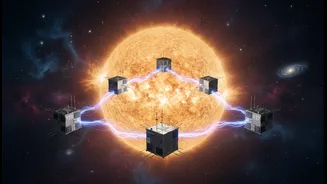
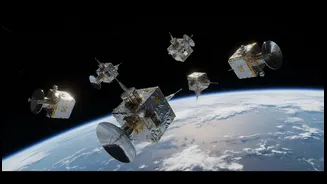
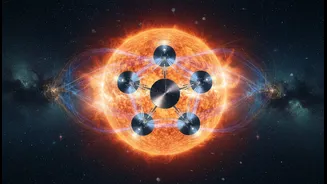
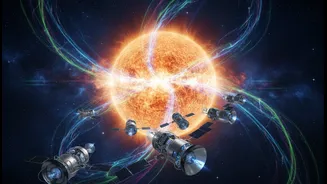
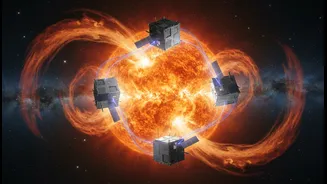
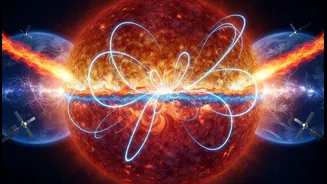
SunRISE, which stands for the Sun Radio Interferometer Space Experiment, is an innovative NASA mission designed to study the Sun's tumultuous activity. Instead of a single, massive satellite, the mission uses a constellation of six small satellites, each
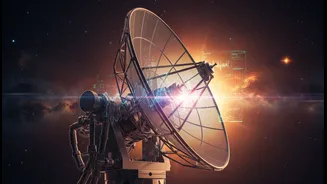
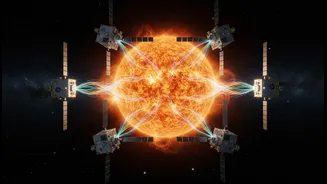
about the size of a toaster oven, flying in a precise formation high above Earth's atmosphere. Together, they function as one giant virtual radio telescope stretching over 10 kilometers wide. This clever design allows them to detect low-frequency radio waves from the Sun that are blocked by our planet's ionosphere and cannot be observed from the ground. Scheduled to launch in the summer of 2026, its primary goal is to get a new view of how the Sun generates massive solar particle storms—the key driver of space weather that can endanger astronauts and disrupt our technology.
Decoding the Sun's Roar
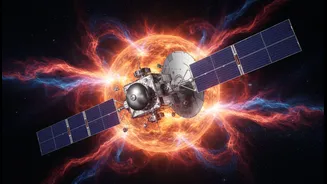
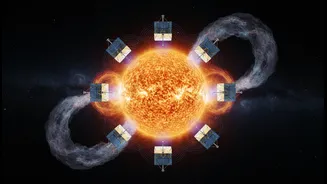
The Sun frequently releases enormous amounts of energy in events like solar flares and Coronal Mass Ejections (CMEs), where it flings billions of tons of its own atmosphere into space. These events are often preceded by powerful solar radio bursts—intense emissions of radio waves. SunRISE is specifically designed to locate and map these radio signals, particularly what are known as Type II bursts. Scientists know that Type II bursts are closely associated with the shockwaves created by CMEs as they blast through the solar corona. By pinpointing the origin of these radio bursts with its virtual telescope, SunRISE can effectively 'see' the birth of a potentially hazardous solar storm and track its initial path away from the Sun, providing crucial data on the physics behind these powerful events.
The Promise of an Early Warning
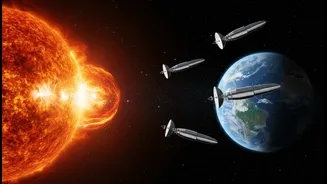
The great promise of SunRISE lies in its potential as an early-warning system. The radio waves it detects travel at the speed of light, reaching us much faster than the CME itself. A strong Type II radio burst can act like a cosmic alarm bell, signaling that a massive eruption has occurred and is heading out into the solar system. This burst is detected about 10 to 20 minutes before the arrival of the most intense, high-energy particles that pose a threat to satellites and astronauts. This advance notice, even if brief, is invaluable. It could give satellite operators time to put their craft into a safe mode and provide astronauts on missions to the Moon or Mars a critical window to take shelter from incoming radiation.
The Question Hiding in Plain Sight
While knowing that a storm is coming is a huge step forward, it's only half the battle. The headline-making critique of missions like SunRISE is that they answer the first, most obvious question—"Did an eruption happen?"—without fully addressing the more difficult, and arguably more important, ones: "Where is it going?" and "How strong will it be when it gets there?" While SunRISE can create 3D maps of the event's origin near the Sun, its ability to provide a precise, long-range trajectory of an Earth-directed CME is limited. It’s the difference between hearing a cannon fire and knowing exactly where the cannonball will land. The mission is a phenomenal diagnostic tool for understanding the physics of particle acceleration, but its direct application for forecasting the specific impact at Earth is less clear.
From Detection to True Prediction
Truly effective space weather forecasting requires more than just detection. It demands predictive power. We need to model a CME's path, its speed, and its magnetic orientation to know if it will glance off Earth's magnetic shield or trigger a major geomagnetic storm capable of crippling power grids and GPS systems. SunRISE is a crucial piece of the puzzle, helping scientists to discriminate between different theories on how solar energetic particles are generated. This foundational science is essential. However, it is not a complete forecast in itself. The "better questions" the scientific community must now ask involve integrating SunRISE's data with other solar observatories and developing advanced computational models that can turn its initial detection into a reliable, actionable prediction of a storm's arrival time and intensity at Earth. SunRISE isn't the final answer, but a vital catalyst for the next generation of space weather science.