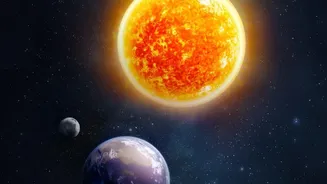







The Equinox: A Moment of Balance
The autumnal equinox, which in 2026 occurs on September 22 or 23 depending on your time zone, is the precise moment the Sun shines directly over the Earth's equator. The word 'equinox' comes from Latin for 'equal night', suggesting day and night are both
12 hours long. In reality, it's not quite that perfect. Because of atmospheric refraction, which bends sunlight, and how we define sunrise and sunset (from the Sun's upper edge), the day of the equinox is actually slightly longer than 12 hours for most places on Earth. This astronomical event marks the official start of autumn in the Northern Hemisphere, signalling a definitive shift in our seasons as the Sun's direct rays cross from the northern to the southern half of the globe.
Earth's Tilt: The Engine of Change
The reason for seasons, and for the changing length of our days, is the Earth's constant 23.5-degree axial tilt. This tilt means that for half the year, the Northern Hemisphere is angled more toward the Sun (our summer), and for the other half, it's angled away (our winter). The equinoxes are the two midway points in this journey, when the tilt is neither toward nor away from the Sun, but perfectly sideways relative to it. After the September equinox, the Northern Hemisphere’s tilt increasingly angles it away from direct sunlight. This causes the Sun to follow a lower path across our sky each day, leading to later sunrises, earlier sunsets, and a steady loss of daylight hours.
The Great Acceleration of Darkness
If you feel like the days are getting shorter faster right now, you’re not imagining it. The rate of daylight loss is not constant throughout the year. It’s slowest around the solstices in June and December, and fastest around the equinoxes in March and September. Think of it like a child on a swing. At the highest points of the arc (the solstices), the swing momentarily hangs almost still before changing direction. In the middle of the arc (the equinoxes), the swing is moving at its fastest. Similarly, around the summer solstice, we lose or gain only about a minute of daylight per day. But around the September equinox, that rate can jump to three minutes or more per day, depending on your location.
Why Is the Change Fastest Now?
The geometry of Earth’s orbit explains this rapid change. At the solstices, the pole of one hemisphere is pointed most directly toward the Sun. As the Earth continues its orbit, the change in how much sunlight that hemisphere receives is very gradual. But at the equinoxes, the Earth's axis is tilted sideways to the Sun. This orientation means that for every day we travel along our orbit, the terminator—the line separating day from night—moves most rapidly across the lines of latitude. The Sun's apparent position in the sky is shifting southward at its quickest pace, resulting in the most dramatic day-to-day shortening of daylight hours.
Location, Location, Location
How quickly you lose daylight after the equinox depends heavily on your latitude. The farther you are from the equator, the more dramatic the change. For example, a city at a higher latitude like Srinagar will lose daylight far more rapidly than a city closer to the equator, such as Kanyakumari. This is because the Sun's path across the sky is much more slanted at higher latitudes. The effect is substantial; a city in northern India might lose over two minutes of daylight per day in late September, while a city in the far south might lose just over a minute. This difference is a direct consequence of the Earth's curve and its unchanging tilt.