





What Is the Square Kilometre Array?
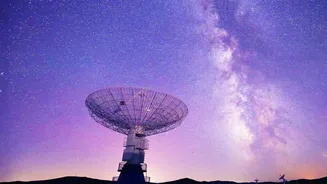
Imagine a telescope not as a single instrument, but as a continent-spanning network of thousands of antennas working together as one. That is the ambition of the Square Kilometre Array. It's not located in one place, but two: a collection of over 131,000
tree-like antennas in Western Australia (SKA-Low) and an array of nearly 200 large satellite dishes in South Africa's Karoo desert (SKA-Mid). Headquartered in the UK, the SKA Observatory is a global collaboration of more than a dozen countries, pooling resources to build the most sensitive radio telescope ever conceived. The name comes from its original goal: to create a total signal-collecting area of one square kilometre. While the first phase is slightly smaller, its power is revolutionary, designed to be 50 times more sensitive and survey the sky 10,000 times faster than any existing radio telescope.
Tuning Into the Cosmic Dawn
The “ancient cosmic radio waves” the SKA is built to detect are not science fiction. They are real electromagnetic signals that have been travelling through space for billions of years. One of the primary targets is faint radiation emitted by neutral hydrogen atoms just a few hundred million years after the Big Bang. This period, known as the Cosmic Dawn, is when the first stars and galaxies began to form, ending the cosmic 'dark ages'. By capturing these signals, astronomers can essentially look back in time to study how the universe evolved from a uniform soup of gas into the structured cosmos we see today. The expansion of the universe has stretched these ancient signals into low-frequency radio waves, making them incredibly faint and difficult to detect amidst the noise from our own galaxy and human activity.
A Technological and Data Giant
The SKA is as much a supercomputing project as it is a telescope. The sheer volume of data produced by the thousands of antennas is staggering, expected to exceed the entire internet's current traffic. In Australia, the SKA-Low antennas will pick up the lowest frequency signals from the early universe. In South Africa, the SKA-Mid dishes, which include the already operational MeerKAT telescope, focus on higher frequencies, ideal for spotting pulsars and molecules that could be precursors to life. Combining the signals from individual antennas spread over vast distances—up to 150 km apart—allows the array to function as one giant telescope with incredible resolution. Recent milestones in 2026 include achieving 'first fringes' at SKA-Mid, where signals from multiple dishes were successfully combined, proving the interferometry concept is working.
India’s Crucial Role in the Cosmic Quest
India is a key player in this global scientific endeavour, having been involved since the project's early days. In 2024, the Indian government approved a contribution of ₹1,250 crore, cementing its position as a full member of the SKA Observatory. The National Centre for Radio Astrophysics (NCRA) in Pune coordinates India’s efforts, leveraging the experience gained from operating its own world-class SKA pathfinder, the Giant Metrewave Radio Telescope (GMRT). Indian scientific and technical expertise is central to the project's brain. A consortium led by NCRA was responsible for designing the Telescope Manager system, the complex software 'nervous system' that will control the entire observatory's operations. Indian institutions are also contributing to digital hardware and are planning a regional data centre to process the vast amounts of information the SKA will generate.
What These Ancient Signals Will Reveal
As the SKA's arrays are assembled and brought online through 2028, they promise to revolutionise our understanding of the universe. By mapping the distribution of hydrogen gas in the early cosmos, scientists hope to answer fundamental questions. How did the first stars ignite? What is the nature of the mysterious dark energy that is accelerating the expansion of the universe? The telescope will also be a powerful tool to test Einstein's theories of gravity by timing the signals from pulsars orbiting black holes and to search for the building blocks of life in the form of complex organic molecules in space. Ultimately, the SKA is not just building a bigger telescope; it is opening an entirely new window onto the cosmos, allowing humanity to witness the universe's infancy for the first time.