

Reading the Surface Like a History Book
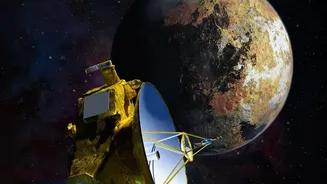
The most fundamental tool in a planetary scientist's toolkit is looking closely at the surface. When the New Horizons spacecraft flew past Pluto in 2015, its high-resolution cameras, like the Long-Range Reconnaissance Imager (LORRI), captured incredibly
detailed pictures. These images allow scientists to perform geological mapping, identifying different types of terrain—from vast, smooth plains to towering mountains and deep valleys. A key technique for dating these surfaces is crater counting. In simple terms, a surface with many impact craters is very old, as it has been exposed to asteroid and comet strikes for billions of years. Conversely, a surface with few or no craters is geologically young, meaning it has been recently resurfaced by processes like volcanism or glacial flows, effectively erasing the older impact scars.
The Beating Heart of Pluto
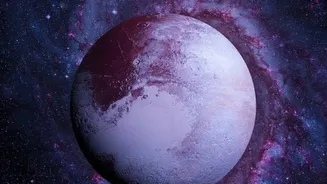
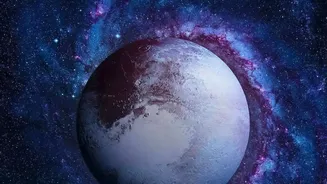
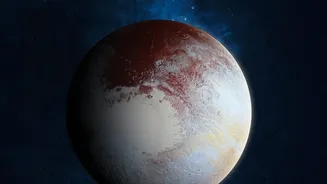
One of the most startling discoveries was Sputnik Planitia, the massive, heart-shaped basin of frozen nitrogen. Images revealed its surface is divided into large, polygon-shaped cells, ranging from 16 to 48 kilometres across. Scientists realised they were looking at the tell-tale signs of slow convection, similar to a cosmic lava lamp. Using computer models, they determined that modest heat from Pluto’s interior warms the solid nitrogen ice at the bottom of the basin. This warmer, more buoyant ice slowly rises, cools at the surface, and then sinks back down along the polygon edges. This constant churning means the surface of Sputnik Planitia is incredibly young in geological terms—estimated to be less than 10 million years old, and possibly as young as a few hundred thousand years. Recent analysis even suggests liquid nitrogen may occasionally seep up through cracks in the glacier.
Ice Volcanoes and Floating Mountains
Pluto also features enormous mountains made not of rock, but of water ice, which is as hard as rock at these frigid temperatures. Some of these mountains rise several kilometres high. Perhaps even more surprising was the discovery of cryovolcanoes—volcanoes that spew a slushy, icy mixture instead of molten lava. Scientists identified a large region of domes and rises, some as tall as 7 kilometres, that appear to have been formed by multiple eruptions. The lack of impact craters in this area suggests this cryovolcanic activity happened relatively recently. This finding is crucial because it implies Pluto retained more internal heat for longer than previously thought possible for such a small, distant world. This heat might be insulated by a layer of gas-trapping structures called clathrates.
Decoding the Chemical Fingerprints
To understand what Pluto is made of, scientists use a technique called spectroscopy. Instruments on New Horizons, like the Ralph/LEISA camera, measured the composition of the surface by analyzing the light reflecting off it. Different materials, like frozen nitrogen, methane, and carbon monoxide, absorb and reflect light in unique ways, creating a chemical fingerprint. This revealed that the vast Sputnik Planitia is dominated by nitrogen ice, while the towering mountains are made of water ice, and other areas are coated in methane frost. Knowing the composition helps scientists understand how these features formed and behave over time. For example, knowing the ice is primarily nitrogen helps confirm the convection models for Sputnik Planitia.
Studying the Hazy Atmosphere
Pluto's thin, nitrogen-rich atmosphere also holds clues. As New Horizons flew past, it turned to look back at the sun setting behind Pluto. An instrument called the Alice ultraviolet spectrograph studied how sunlight filtered through the atmosphere. This revealed not only the atmosphere's composition—mostly nitrogen with traces of methane and other hydrocarbons—but also that it features more than a dozen distinct haze layers extending over 1,600 kilometres high. These hazes are thought to be created when solar ultraviolet light breaks down methane gas, forming more complex hydrocarbon particles. These particles then slowly settle onto the surface, possibly contributing to the reddish and dark materials seen in images. By tracking the atmosphere over time using stellar occultations—where Pluto passes in front of a distant star—scientists can even watch it shrink and thin as the dwarf planet moves farther from the sun.